Tan Balance
Dr. Richard Tan's Balance Method — a distal acupuncture system closely related to Master Tung's family acupuncture. Needles go into the limbs, never into the painful area itself, chosen by anatomical correspondence and channel-pairing logic.
1. Anatomical Correspondence — Imaging & Mirroring
This is the part of the method that decides where on a limb to needle, independent of which meridian is involved — by treating one part of the body as a proportional map of another.
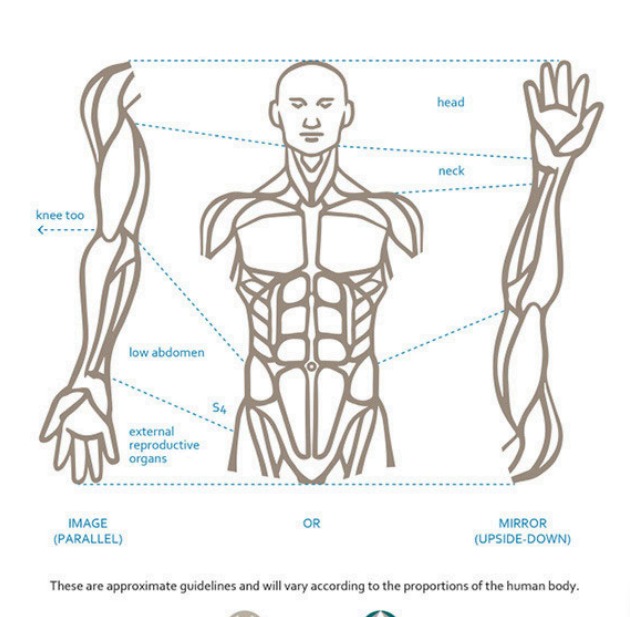
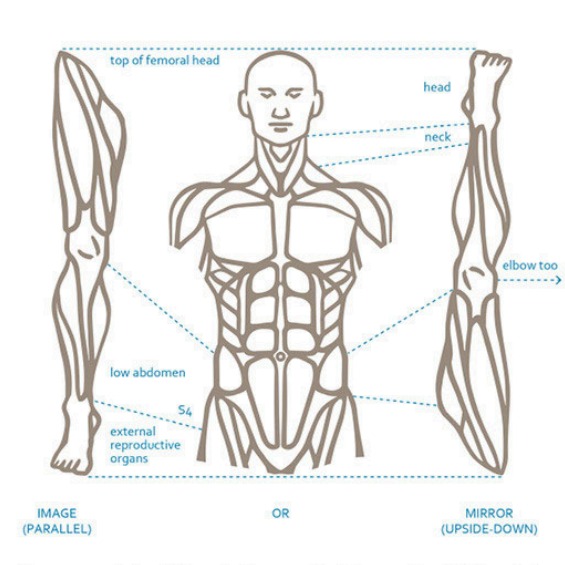
The forearm (or lower leg) is treated as a small-scale image of the whole torso: the hand/foot end represents the head, and moving up the limb passes through neck, chest, abdomen, down to the low abdomen and external reproductive organs near the elbow/knee. It can be mapped in the same orientation ("Image") or flipped end-to-end ("Mirror").
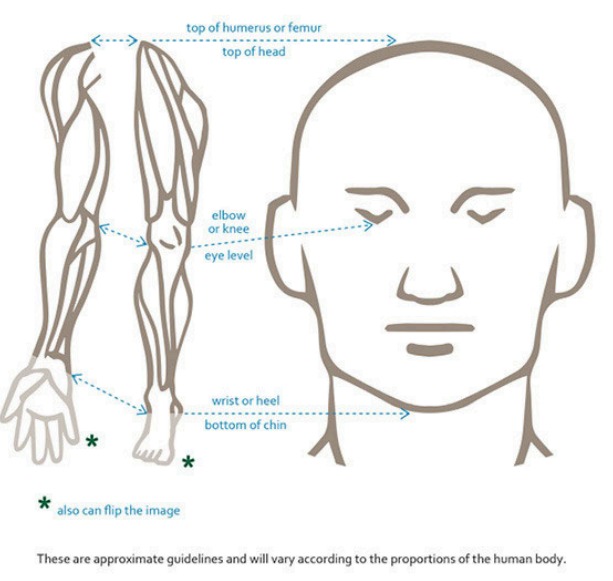
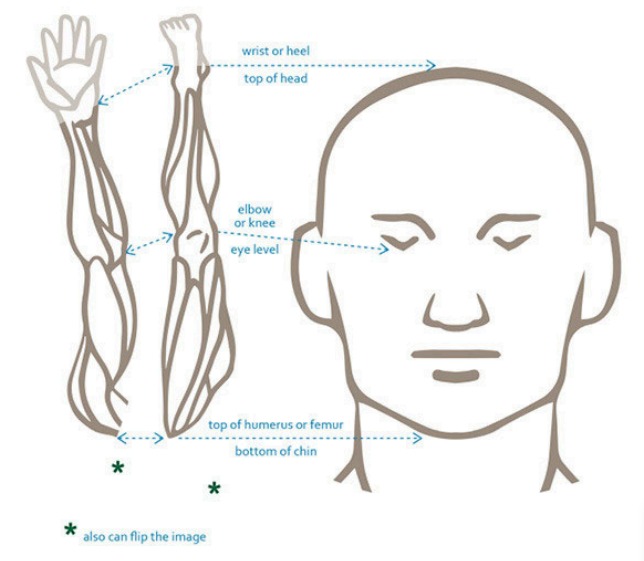
The same limb can instead represent just the face: top of the humerus/femur = top of the head, elbow/knee = eye level, wrist/heel = bottom of the chin. Useful for headache, TMJ, facial pain and similar head/face complaints without needling the face itself.
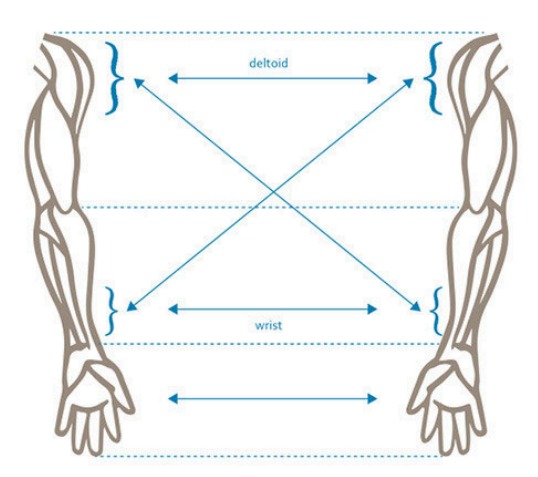
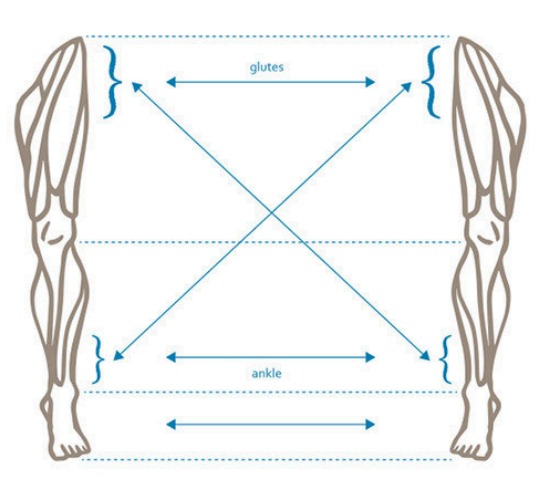
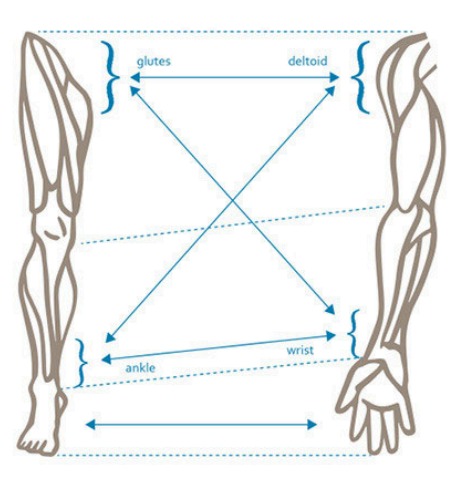
The most basic form of correspondence — one joint stands in for its opposite-number joint elsewhere on the body:
Beyond the straight same-side or same-limb-type mirroring above, regions also correspond diagonally across the body — a shoulder (deltoid) region relates to the wrist of the opposite arm, and a hip (glute) region to the ankle of the opposite leg, giving a choice of which specific point to use.
2. Channel-Pairing — the Six Systems
This is the part of the method that decides which meridian to needle on the healthy limb, based on the meridian running through the painful area. Any one complaint can usually be approached through more than one of these six relationships — see 12 Meridians for the channel course/pairing reference.
| System | Relationship | Worked example |
|---|---|---|
| 1. Same meridian | Needle the same channel, away from the affected site. | Shoulder pain on the Large Intestine channel → a Large Intestine point on the leg/other arm. |
| 2. Same-name (Chinese anatomical image) | Pairs the same-named Hand and Foot meridian (e.g. both "Yang Ming"). | Large Intestine (Hand Yang Ming) pain → treat Stomach channel (Foot Yang Ming). |
| 3. Branching (Bie Jing) | Pairs meridians that meet via the classical divergent-channel (Jing Bie) confluences. | Lung complaint → Bladder channel, its paired branch. |
| 4. Interior–Exterior (Biao Li) | Pairs the two organ-related meridians sharing an Interior/Exterior relationship. | Stomach (Yang) disorder → Spleen (Yin) channel. |
| 5. Opposite (Chinese Clock) | Pairs meridians roughly 12 hours apart on the Chinese organ clock. | Stomach-time complaint → Pericardium channel. |
| 6. Neighbour (Chinese Clock) | Pairs meridians adjacent on the Chinese organ clock. | Stomach-time complaint → Large Intestine channel. |
For any affected meridian (left column), the corresponding meridian to consider under each of systems 2–6. System 1 (same meridian) isn't shown — it's always just the same channel, needled elsewhere on a healthy limb. The table is symmetric: read it in either direction (e.g. Lung ↔ Bladder under Branching works both ways).
| Meridian | 2. Same-name | 3. Branching | 4. Interior-Ext. | 5. Opposite | 6. Neighbour |
|---|---|---|---|---|---|
| LU — Lung | SP | BL | L.I. | BL | LIV |
| L.I. — Large Intestine | ST | LIV | LU | KI | ST |
| ST — Stomach | L.I. | P | SP | P | L.I. |
| SP — Spleen | LU | S.I. | ST | T.B. | HE |
| HE — Heart | KI | G.B. | S.I. | G.B. | SP |
| S.I. — Small Intestine | BL | SP | HE | LIV | BL |
| BL — Bladder | S.I. | LU | KI | LU | S.I. |
| KI — Kidney | HE | T.B. | BL | L.I. | P |
| P — Pericardium | LIV | ST | T.B. | ST | KI |
| T.B. — Triple Burner | G.B. | KI | P | SP | G.B. |
| G.B. — Gall Bladder | T.B. | HE | LIV | HE | T.B. |
| LIV — Liver | P | L.I. | G.B. | S.I. | LU |
3. Putting It Together — Worked Example
A single complaint is treated by combining an anatomical correspondence (Section 1) with a channel-pairing relationship (Section 2) — this is what narrows "somewhere on the opposite limb" down to a specific point.
- Pick the anatomical zone — mirroring says shoulder ↔ hip, or the deltoid cross-correspondence points to the opposite wrist.
- Pick the meridian — same-name system: Large Intestine (Hand Yang Ming) pairs with Stomach (Foot Yang Ming).
- Combine both — needle a Stomach-channel point around the hip/thigh region on the healthy (left) leg, ideally at a spot tender to palpation.
- Reassess — ask the patient to move the shoulder through the painful range while the needle is in place; adjust depth/angle if the response is only partial.
Spot an error, or have more to add? Send it to admin on WhatsApp and it'll be corrected/added here.
+91 99083 14510