Logout 📊 Admin
🏠 Home
Spleen Channel — Teaching Deck (12 points)

SP-1

Yinbai "Hidden White"
Spleen ChannelWell (Jing) PointWood PointGhost Point

Location

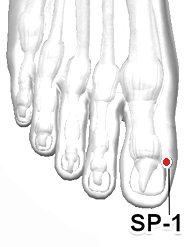
Location of SP-1 (Yinbai)

Actions

  • Regulates the Spleen
  • Stops bleeding
  • Calms the Mind
Key point: SP-1 + direct moxa is the classic combination to stop bleeding from anywhere in the body (nose, stomach, bladder, intestines, uterus) by strengthening the Spleen's Blood-holding function.

Indications

Digestive

Abdominal distension, diarrhoea, vomiting, no desire to eat.

Bleeding

Uterine bleeding, blood in the urine or stools, vomiting blood, nosebleed (incl. febrile disease with nosebleed).

Mental / Emotional

Agitation, sighing, sadness, manic depression, excessive dreaming, insomnia.

Clinical Pearls (summarized from Comments)

  • Mainly an Excess-pattern point - unusual for a Well (Jing) point.
  • Direct moxa is the classic technique for its haemostatic (bleeding-stopping) action.
  • Also used for mental restlessness/depression from Blood stasis - calms the Mind, stops excessive dreaming.

SP-2

Dadu "Big Capital"
Spleen ChannelSpring (Ying) PointFire PointTonification Point

Location

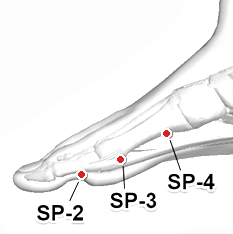
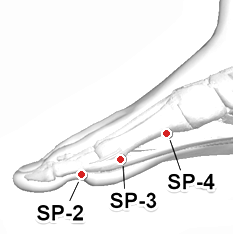
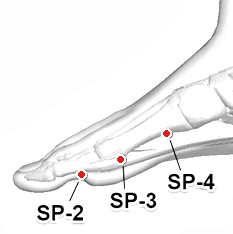
Location of SP-2 (Dadu)

Actions

  • Regulates the Spleen
  • Resolves Dampness
  • Clears Heat
  • Calms the Mind
Key point: Despite being the classical Five-Element “tonification point” of the Spleen, SP-2 is actually used far more often to clear Heat than to tonify - a common point of confusion for students.

Indications

Digestive

Abdominal distension, epigastric pain, vomiting, diarrhoea, constipation.

Dampness / Heat

Sudden swelling of limbs, feeling of heaviness of the body, oppression of the chest, febrile disease without sweating.

Mental

Agitation, insomnia.

Clinical Pearls (summarized from Comments)

  • Main clinical use: clear Heat in Excess patterns, especially early-stage febrile disease from exterior Heat (induces sweating, clears Heat).
  • Calms the Mind when unsettled by Heat in the Spleen_pencil_sketch/Stomach.

SP-3

Taibai "Supreme White"
Spleen ChannelSource (Yuan) PointStream (Shu) PointEarth Point

Location

Location of SP-3 (Taibai)

Actions

  • Strengthens the Spleen
  • Stimulates the Intellect (Yi)
  • Resolves Dampness
  • Regulates the Intestines
  • Strengthens the spinal muscles
Key point: Source point of the Spleen channel and Earth point of an Earth channel — the “centre of the centre.” The single most important point to tonify the Spleen in any deficiency pattern.

Indications

Digestive

Deficiency of Spleen and Stomach, tiredness, poor appetite, borborygmi, diarrhoea, undigested food in the stools, constipation, abdominal pain and distension, epigastric distension and pain.

Mental / Cognitive

Poor memory, confused thinking, muzziness of the head, difficulty concentrating.

Dampness

Feeling of heaviness of the body and four limbs, heaviness and muzziness of the head, dull frontal headache.

Musculoskeletal

Chronic backache against a background of Spleen and Kidney deficiency.

Clinical Pearls (summarized from Comments)

  • Stimulates the Intellect (Yi) - useful when Spleen-Qi is weakened by excessive mental work, incl. postviral chronic fatigue syndrome.
  • A major Dampness-resolving point for Upper, Middle, or Lower Burner - needle with reducing method for this purpose; especially good for Dampness affecting the head.
  • Used in chronic Phlegm retention in the Lungs - reinforcing SP-3 tonifies Earth to nourish Metal, treating Phlegm at its Spleen root.
  • Lesser-known use: strengthens the spine - helpful for chronic backache (Su Wen ch. 4: “the Spleen controls the spine”).

SP-4

Gongsun "Minute Connecting Channels"
Spleen ChannelConnecting (Luo) PointOpening Point — Penetrating Vessel (Chong Mai)

Location

Location of SP-4 (Gongsun)

Actions

  • Harmonizes the Middle Burner
  • Regulates the Intestines
  • Regulates the Penetrating Vessel
  • Calms the Mind, opens the Mind's orifices
  • Stops bleeding
  • Regulates menstruation
  • Benefits feet and toes
Key point: One of the 8 Confluent/Opening points of the Extraordinary Vessels — opens the Penetrating Vessel (Chong Mai, “Sea of Blood”), giving it unusually wide reach across digestive, gynaecological, and chest/Heart-Mind symptoms at once.

Indications

Digestive

Epigastric fullness/distension/pain, oesophageal constriction, abdominal fullness, distension and pain, borborygmi, diarrhoea, undigested food in the stools.

Mental / Chest

Manic depression, anxiety, insomnia, mental restlessness, chest pain.

Gynaecological / Bleeding

Blood in the stools, uterine bleeding, painful or irregular periods, retention of placenta or lochia.

Feet

Heel pain, numbness or cold feet, hot soles, arch pain, big toe pain, fungal infection of the big toe.

Clinical Pearls (summarized from Comments)

  • Treats Excess patterns of Stomach_pencil_sketch/Spleen: Dampness retained in the epigastrium, Stomach-Qi rebelling upward.
  • Via the Penetrating Vessel: regulates menstruation, stops bleeding from any part of the body (not just digestive), and treats anxiety/chest tightness/insomnia (the Vessel affects Heart and Mind).
  • All Luo points of Yin channels stop bleeding in their own channel - SP-4 additionally stops bleeding anywhere via its Penetrating Vessel connection.
  • Also treats foot/heel pain and cold, numb feet via the Vessel's descending branch to the sole and big toe.

SP-5

Shangqiu "Metal Mound"
Spleen ChannelRiver (Jing-River) PointMetal PointSedation Point

Location

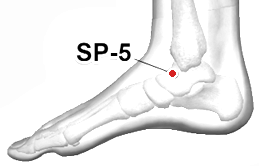
Location of SP-5 (Shangqiu)

Actions

  • Strengthens the Spleen
  • Regulates the Intestines
  • Resolves Dampness
  • Benefits sinews and joints
  • Calms the Mind, opens the Mind's orifices
Key point: As the River point, this is where the channel's Qi is diverted to bones and joints — making SP-5 (and River points generally) a go-to choice for chronic Painful Obstruction Syndrome (Bi) from Dampness.

Indications

Digestive / Deficiency

Spleen deficiency, tiredness, lassitude, somnolence, desire to lie down; abdominal distension, borborygmi, diarrhoea, undigested food, constipation.

Musculoskeletal

Sinew pain/contraction, ankle pain, inner thigh pain, Bone Bi Syndrome, heaviness of the body with painful joints.

Mental

Manic depression, agitation, excessive pensiveness, inappropriate laughter, nightmares, melancholy.

Clinical Pearls (summarized from Comments)

  • Best used for chronic Bi Syndrome from Dampness, especially of the knee or ankle.
  • Works as a general River-point strategy for Damp-Bi on any channel, not just the Spleen.
  • Name means “Metal Mound” (not the more common “Merchant Mound” translation) - “Metal” here refers to its Five-Element point type.

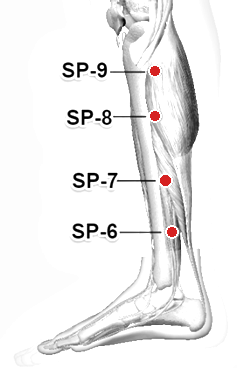
SP-6

Sanyinjiao "Three Yin Meeting"
Spleen ChannelMeeting Point — 3 Leg Yin Channels (Spleen • Liver • Kidney)

Location

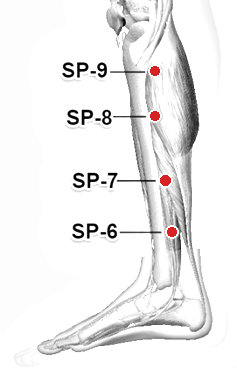
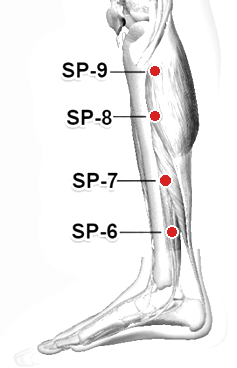
Location of SP-6 (Sanyinjiao)

Actions

  • Strengthens the Spleen
  • Resolves Dampness
  • Smooths the flow of Liver-Qi
  • Tonifies the Kidneys
  • Nourishes Blood and Yin
  • Benefits urination
  • Regulates the uterus and menstruation
  • Moves Blood, eliminates stasis
  • Cools Blood
  • Stops pain
  • Calms the Mind
Key point: Arguably the single most important point on the Spleen channel — meeting point of all three Leg Yin channels (Spleen, Liver, Kidney), giving it simultaneous action on Qi, Blood, and Yin.

Indications

Digestive

Spleen_pencil_sketch/Stomach deficiency, heaviness, oedema, abdominal fullness and distension, cold abdomen, umbilical pain.

Head & Senses

Dizziness, blurred vision, tinnitus.

Gynaecological

Irregular menstruation, infertility, excessive uterine bleeding, painful periods, abdominal masses, retention of lochia or dead fetus.

Urogenital

Difficult urination, enuresis, turbid urine, seminal emissions, impotence, sexual hyperactivity, pain in the penis, contracted testicles.

Mental

Palpitations, insomnia, timidity (Gall Bladder-deficiency type).

Clinical Pearls (summarized from Comments)

  • Combined with ST-36: powerfully tonifies Middle Burner Qi/Blood - classic combo for chronic tiredness.
  • Major Dampness-resolving point for the Lower Burner, Damp-Cold or Damp-Heat alike - vaginal discharge, mucus in the stools, cloudy or painful urination.
  • Via the Liver channel: smooths Liver-Qi (abdominal pain/distension, constipation, painful periods) and calms irritability.
  • Via the Kidney channel: tonifies Kidney-Yin - dizziness, tinnitus, night sweating, dry mouth.
  • Deep action on Blood: nourishes, invigorates (removes stasis), and cools it - used in dysmenorrhoea, Blood-Heat skin disease, and to stop bleeding.
  • Essential gynaecological point: regulates the uterus/period, treats leukorrhoea, menorrhagia, dysmenorrhoea.
  • Strong calming action on the Mind - insomnia especially from Blood or Yin deficiency (e.g. Spleen- and Heart-Blood deficiency).
SP-8

Diji "Earth Pivot"
Spleen ChannelAccumulation (Xi) Point

Location

Location of SP-8 (Diji)

Actions

  • Harmonizes the Spleen, resolves Dampness
  • Regulates Qi and Blood
  • Regulates the Uterus
  • Removes obstructions from the channel
  • Stops pain
  • Stops bleeding
Key point: As an Accumulation (Xi) point, SP-8 is the acute-pain/emergency point of the Spleen channel — best for acute dysmenorrhoea and acute bleeding, not chronic conditions.

Indications

Digestive

Abdominal distension and pain, poor appetite.

Gynaecological

Irregular menstruation, painful periods, abdominal masses (Zheng Jia), excessive menstrual bleeding.

Bleeding

Blood in the stools.

Clinical Pearls (summarized from Comments)

  • Classic use: acute dysmenorrhoea (reducing method, used just before the period to move Qi/Blood); combine with reinforcing-method points elsewhere to treat the chronic root.
  • Stops acute bleeding: excessive menstrual bleeding, bleeding from the bowel.
  • Name “Earth Mechanism” links to regulating the Qi Mechanism - the ascending/descending, entering/exiting of Qi.

SP-9

Yinlingquan "Yin Mound Spring"
Spleen ChannelSea (He) PointWater Point

Location

Location of SP-9 (Yinlingquan)

Actions

  • Regulates the Spleen
  • Resolves Dampness
  • Opens the Water passages
  • Benefits the Lower Burner
  • Benefits urination
Key point: The premier point for resolving Dampness from the Lower Burner — Damp-Cold or Damp-Heat alike, this is a first-choice point (needle with reducing method to eliminate Dampness).

Indications

Digestive

Abdominal distension and pain, poor appetite, diarrhoea.

Fluid / Oedema

Oedema, swelling of the legs.

Urinary

Difficult urination, retention of urine, enuresis, painful urination.

Musculoskeletal

Swollen knees, Bi Syndrome of the legs.

Clinical Pearls (summarized from Comments)

  • Broad Lower-Burner Damp indications: difficult/painful urination, cloudy urine, vaginal discharge, foul-smelling diarrhoea, mucus in the stools, leg/abdominal oedema.
  • Also treats Damp Bi Syndrome of the knee, especially when the knee is visibly swollen.

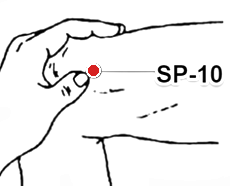
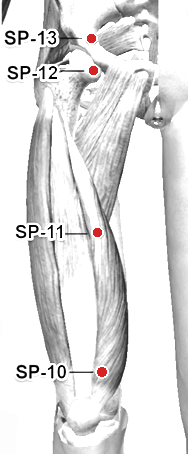
SP-10

Xuehai "Sea of Blood"
Spleen ChannelNo special Five-Element classification

Location

Location of SP-10 (Xuehai)

Actions

  • Cools Blood
  • Invigorates Blood and eliminates stasis
Key point: “Sea of Blood” - genuinely performs all three Blood actions (cools, invigorates, and with reinforcing method even nourishes), despite historical debate over which is its “real” function.

Indications

Skin

Urticaria, eczema, erysipelas, herpes zoster, hot sores, itching of the scrotum or genitals.

Gynaecological

Irregular menstruation, painful periods, amenorrhoea, uterine bleeding (incl. sudden bleeding after childbirth).

Clinical Pearls (summarized from Comments)

  • Cools Blood especially for the skin (urticaria, rashes) - the classic textbook use.
  • Also invigorates Blood in the Uterus (painful periods) and stops uterine bleeding.
  • Reinforcing method can nourish Blood too, though SP-6 is usually preferred for that specific purpose.
  • Alternate name “Xuexi” (“Blood Accumulation point”) - functions like an Xi-point for Blood even though it isn't formally classified as one.

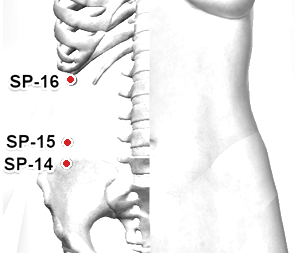
SP-12

Chongmen "Penetrating Door"
Spleen ChannelMeeting Point (Spleen • Liver)Point of the Yin Linking Vessel (Yin Wei Mai)

Location

Location of SP-12 (Chongmen)

Actions

  • Moves Qi and invigorates Blood
  • Subdues rebellious Qi of the Penetrating Vessel
  • Resolves Dampness and benefits urination
Key point: Shares a character with Chong Mai (Penetrating Vessel) in its name — explains its signature use for rebellious Qi “rushing upward to harass the Heart”, e.g. during pregnancy.

Indications

Digestive / Abdominal

Abdominal fullness and pain, abdominal masses (Ji Ju), haemorrhoids.

Reproductive

Fetal Qi rushing upward to harass the Heart, difficult lactation.

Urinary

Difficult or retention of urination, painful urination, excessive vaginal discharge.

Clinical Pearls (summarized from Comments)

  • Local point for hip Bi Syndrome when the pain radiates to the groin.

SP-15

Daheng "Big Horizontal Stroke"
Spleen ChannelPoint of the Yin Linking Vessel (Yin Wei Mai)

Location

Location of SP-15 (Daheng)

Actions

  • Strengthens the Spleen
  • Strengthens the limbs
  • Regulates Qi
Key point: An underrated point for deficiency-type chronic constipation — when Spleen-Qi is too weak to move the Large Intestine (not for Excess-type constipation).

Indications

Emotional

Sighing, sadness, tiredness, poor appetite.

Musculoskeletal

Inability to raise or move the four limbs, weakness of the limbs.

Digestive

Abdominal pain, cold lower abdomen, chronic diarrhoea with mucus in the stools, constipation.

Clinical Pearls (summarized from Comments)

  • Strengthens the Spleen's transport function specifically toward the limbs - good for cold, weak limbs from Spleen deficiency.
  • Also resolves Dampness in the Intestines (mucus in the stools).
  • Can relieve abdominal pain from Liver-Qi stagnation too, via its Qi-regulating action.

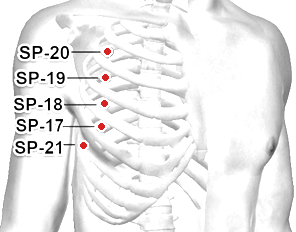
SP-21

Dabao "General Control"
Spleen ChannelConnecting Point — Great Connecting Channel of the Spleen

Location

Location of SP-21 (Dabao)

Actions

  • Invigorates Blood in the Blood Connecting channels
  • Benefits the sinews
  • Regulates Qi in the chest
Key point: One of only two points (with Ren-15) governing a “Great Luo” channel — SP-21 specifically controls all Blood Connecting channels throughout the entire body, explaining its unique use for generalized, migratory body pain.

Indications

Generalized

Pain in the whole body.

Musculoskeletal

Weak or flaccid limbs, weak joints.

Chest / Respiratory

Cough, breathlessness, chest pain, rib pain, hypochondrial distension.

Clinical Pearls (summarized from Comments)

  • Classic indication: generalized muscular pain that moves around the body, from Blood stasis in the Connecting channels.
  • Name “General Control” reflects this body-wide controlling action over the Blood Connecting channels.