Logout 📊 Admin
🏠 Home
Liver Channel — Teaching Deck (10 points)

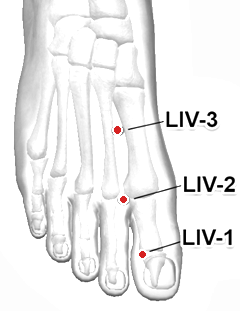
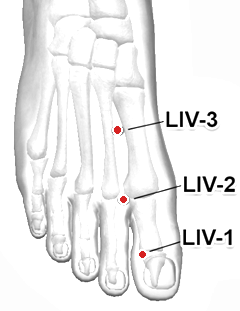
LIV-1

Dadun "Big Mound"
Liver ChannelWell (Jing) PointWood Point

Location

Location of LIV-1 (Dadun)

Actions

  • Regulates menstruation
  • Resolves Damp-Heat in the genitourinary system
  • Promotes resuscitation
Key point: A major point for Hernial and Genitourinary Disorders (Shan) — the Liver channel's broad category covering hernia-type protrusions, external genital disease, and severe abdominal pain with urinary retention.

Indications

Gynaecological

Irregular periods, excessive uterine bleeding, prolapse of uterus.

Genitourinary

Swelling and pain of the genitalia, retraction of genitals, retention of urine, blood in urine, painful, frequent or difficult urination, turbid urine.

Emergency

Loss of consciousness, epilepsy.

Clinical Pearls (summarized from Comments)

  • Stops uterine bleeding specifically from Heat in the Blood - not indicated for bleeding from Qi deficiency.
  • Restores consciousness in acute Wind-stroke, like other Well points.
LIV-2

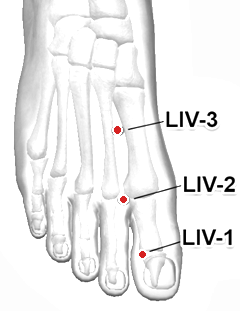
Xingjian "Temporary in-Between"
Liver ChannelSpring (Ying) PointFire PointDrainage Point

Location

Location of LIV-2 (Xingjian)

Actions

  • Drains Liver-Fire and subdues Liver-Yang
  • Extinguishes interior Wind
  • Cools Blood and stops bleeding
  • Calms the Mind
  • Resolves Damp-Heat in the genitourinary system
Key point: The point to drain Liver-Fire specifically, not just Liver-Yang or Wind — its Blood-cooling action is diagnostic: bleeding is a hallmark consequence of Liver-Fire, unlike plain Liver-Heat or Liver-Yang rising, which don't cause bleeding.

Indications

Liver-Fire

Bitter taste, headache, thirst, dark urine, dry stools, irritability, propensity to outbursts of anger, red eyes, dizziness.

Neurological

Wind-stroke, deviation of eye and mouth, tetany, epilepsy, loss of consciousness.

Bleeding

Excessive menstrual bleeding, coughing of blood, vomiting of blood.

Mental

Sadness, fright, manic behaviour, insomnia, palpitations.

Genitourinary

Pain and itching of genitals, Hernial and Genitourinary Disorders, painful or difficult urination, excessive vaginal discharge, constipation.

Clinical Pearls (summarized from Comments)

  • Also the main point to clear Liver-Fire when it causes cough, via the Liver “insulting” the Lungs in the Five-Element Insulting cycle.
  • A harsher, stronger point than LIV-3 for these purposes.

LIV-3

Taichong "Bigger Penetrating"
Liver ChannelSource (Yuan) & Stream (Shu) PointEarth PointMa Dan Yang Heavenly Star Point

Location

Location of LIV-3 (Taichong)

Actions

  • Subdues Liver-Yang
  • Extinguishes interior Wind
  • Promotes the smooth flow of Liver-Qi
  • Resolves Dampness
  • Invigorates Blood and regulates menstruation
  • Calms the Mind
  • Calms spasms
Key point: The channel's flagship point — gentler than LIV-2, and uniquely dual-purpose: mainly drains Liver-Yang/Excess, but can also be reinforced to nourish Liver-Blood; it directly activates the Penetrating Vessel (its name shares the character “chong” with Chong Mai — the Vessel was historically even called the “Taichong Vessel”).

Indications

Head

Headache, dizziness, blurred vision, numbness of head.

Neurological

Opisthotonos, epilepsy, deviation of eye and mouth.

Digestive

Hypochondrial distension, irritability, epigastric and abdominal distension, sighing, breast distension, nausea, constipation.

Genitourinary

Hypogastric fullness, Hernial and Genitourinary Disorders, swollen testicles, difficult urination, jaundice.

Gynaecological

Amenorrhoea, irregular or painful periods, excessive menstrual bleeding, prolapse of uterus.

Mental

Propensity to outbursts of anger, irritability, insomnia, worrying.

Musculoskeletal

Cramps, stiffness of the lower back with inability to bend, contracture of sinews.

Clinical Pearls (summarized from Comments)

  • Compared with LIV-2 : LIV-2 specifically drains Liver-Fire only, has no strong calming effect, is drain-only, has no specific spasm action, is harsher, mainly subdues rebellious Qi, and is head-focused. LIV-3 subdues Liver-Yang more broadly, has a strong Mind-calming effect, can also nourish Liver-Blood, calms spasms specifically, is gentler, both subdues rebellious Qi and promotes smooth Qi flow, and affects the head, epigastrium, hypochondrium, abdomen and genitals.
  • “Four Gates” combination with L.I.-4 - expels Wind from the face (facial paralysis, tic), calms the Mind, and regulates the ascending/descending of Qi.
  • A major gynaecological point via Penetrating Vessel activation - invigorates Uterine Blood, the key point for Blood-stasis dysmenorrhoea.
  • Resolves Dampness from the genitourinary system and the Liver_pencil_sketch/Gall Bladder (jaundice); with reducing method plus moxa, expels Cold from the channel - orchitis, chronic leukorrhoea.

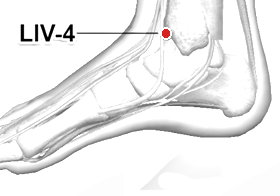
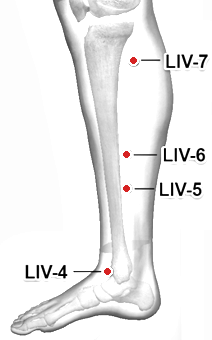
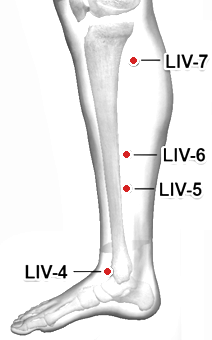
LIV-4

Zhongfeng "Middle Seal"
Liver ChannelRiver (Jing-River) PointMetal Point

Location

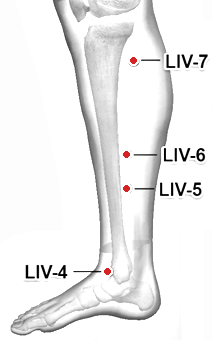
Location of LIV-4 (Zhongfeng)

Actions

  • Promotes the smooth flow of Liver-Qi in the Lower Burner
  • Resolves Dampness in the genitourinary system
Key point: Promotes smooth Liver-Qi flow specifically in the Lower Burner and genitourinary region — a narrower, more targeted version of LIV-1/LIV-3's Hernial-Disorder action.

Indications

Abdominal

Hypogastric and abdominal distension, umbilical pain.

Genitourinary

Pain and retraction of genitals, Hernial and Genitourinary Disorders, difficult or painful urination, turbid urine, retention of urine, swelling of lower abdomen.

Clinical Pearls (summarized from Comments)

    LIV-5

    Ligou "Gourd Ditch"
    Liver ChannelConnecting (Luo) Point

    Location

    Location of LIV-5 (Ligou)

    Actions

    • Promotes the smooth flow of Liver-Qi
    • Resolves Damp-Heat in the genitourinary system
    Key point: The Liver's Luo channel departs from this point and encircles the genitals — explaining its strong genitourinary affinity, but via its ascending pathway it also treats “Plum-Stone Syndrome” (a sensation of a lump in the throat from emotional Liver-Qi stagnation).

    Indications

    Abdominal

    Hypogastric and abdominal distension, abdominal fullness.

    Genitourinary

    Hernial and Genitourinary Disorders, itching, swelling and pain of genitals, priapism, difficult urination, retention of urine.

    Clinical Pearls (summarized from Comments)

      LIV-6

      Zhongdu "Middle Capital"
      Liver ChannelAccumulation (Xi) Point

      Location

      Location of LIV-6 (Zhongdu)

      Actions

      • Removes obstructions from the channel
      Key point: Shares LIV-4/LIV-5's genitourinary affinity but, as the Xi point, is specifically useful for acute urinary pain (e.g. cystitis) from Damp-Heat and Liver-Qi stagnation.

      Indications

      Abdominal / Musculoskeletal

      Lower abdominal or hypogastric pain, cold lower leg, pain in the inner aspect of the leg.

      Clinical Pearls (summarized from Comments)

        LIV-7

        Xiguan "Knee Gate"
        Liver ChannelNo special Five-Element classification

        Location

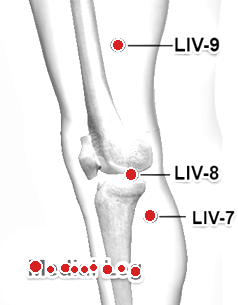
        Location of LIV-7 (Xiguan)

        Actions

        • Resolves Dampness and expels Wind
        • Benefits the knee
        Key point: A local point for medial knee Bi Syndrome, particularly when arising from Wind.

        Indications

        Musculoskeletal

        Swelling and pain of the knee, pain on the inner aspect of the knee, Bi Syndrome, rigidity of the knee.

        Clinical Pearls (summarized from Comments)

          LIV-8

          Ququan "Spring on Bend"
          Liver ChannelSea (He) PointWater PointTonification Point

          Location

          Location of LIV-8 (Ququan)

          Actions

          • Benefits the Bladder and genitals
          • Resolves Dampness from the Lower Burner
          • Invigorates Blood and regulates menstruation
          • Nourishes Liver-Blood
          Key point: Dual-natured like LIV-3 — mainly used to eliminate Lower Burner Dampness (Damp-Heat or Damp-Cold), but with reinforcing method becomes an important Liver-Blood tonic.

          Indications

          Genitourinary

          Swelling and itching of genitals, pain in the penis, impotence, difficult urination, retention of urine.

          Gynaecological

          Abdominal masses in women, painful periods, amenorrhoea, infertility from Blood stasis, umbilical pain.

          Clinical Pearls (summarized from Comments)

          • Combine with ST-36, SP-6 and Ren-4 to nourish Liver-Blood (the author's clinical combination).
          • Also invigorates Uterine Blood - used for painful periods and abdominal masses.

          LIV-13

          Zhangmen "Completion Gate"
          Liver ChannelFront Collecting (Mu) Point — SpleenGathering (Hui) Point — 5 Yin OrgansMeeting Point (Liver • Gall Bladder)

          Location

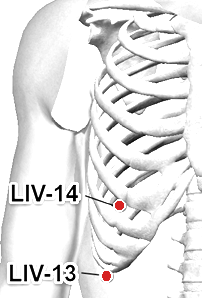
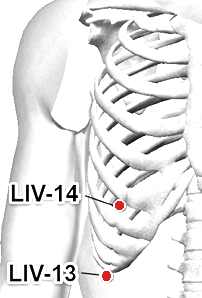
          Location of LIV-13 (Zhangmen)

          Actions

          • Promotes the smooth flow of Liver-Qi and harmonizes Liver and Spleen
          Key point: The main point for Liver-invading-Spleen disharmony (classic Wiry-left/Weak-right pulse) — promotes Liver-Qi flow while simultaneously strengthening the Spleen.

          Indications

          Digestive

          Hypochondrial distension, pain in the ribs, abdominal distension and pain, diarrhoea, undigested food in the stools, borborygmi, constipation.

          Clinical Pearls (summarized from Comments)

          • With reinforcing method (or moxa added), can directly tonify Stomach and Spleen, and warm Spleen-Yang deficiency.

          LIV-14

          Qimen "Cyclic Gate"
          Liver ChannelFront Collecting (Mu) Point — LiverPoint of the Yin Linking Vessel (Yin Wei Mai)Meeting Point (Spleen • Liver)

          Location

          Location of LIV-14 (Qimen)

          Actions

          • Promotes the smooth flow of Liver-Qi and harmonizes Liver and Stomach
          Key point: The Stomach-focused counterpart to LIV-13 (which is more Spleen-focused) — treats Liver-Qi invading the Stomach specifically; classic pulse sign is Wiry on both Middle (Guan) positions.

          Indications

          Digestive

          Hypochondrial distension, sighing, breast distension, epigastric distension and pain, hiccup, belching, vomiting, hardness of epigastrium.

          Clinical Pearls (summarized from Comments)

          • Has two recognized locations - one in the intercostal space (used more for channel problems) and one at the lower edge of the ribcage (used more for organ problems) - effectively treated as two related points in practice.