Logout 📊 Admin
🏠 Home
Lung Channel — Teaching Deck (10 points)

LU-1

Zhongfu "Central Palace"
Lung ChannelFront Collecting (Mu) Point — LungsMeeting Point (Lung • Spleen)

Location

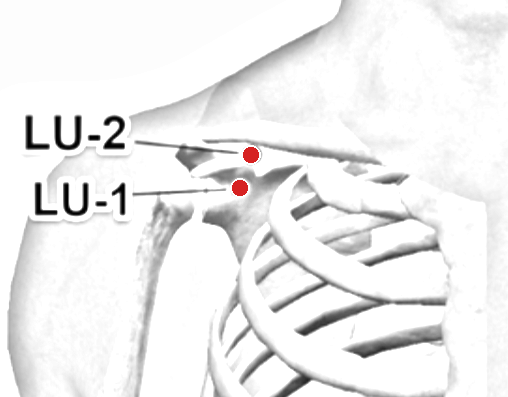
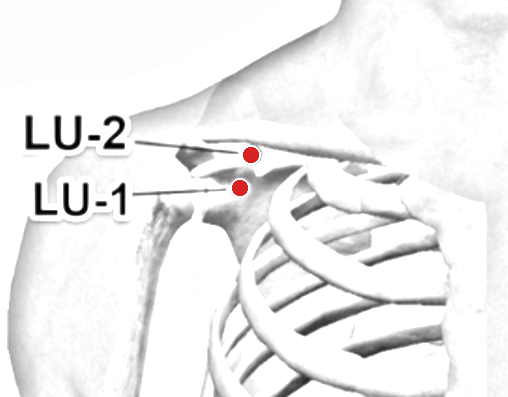
Location of LU-1 (Zhongfu) and LU-2 (Yunmen)

Actions

  • Promotes the descending of Lung-Qi and stops cough
  • Resolves Phlegm from the Lungs
  • Disperses fullness from the chest and stops chest pain
Key point: As the Front-Mu (Collecting) point of the Lungs, LU-1 is the classic choice for acute, Excess-type Lung conditions — its natural counterpart is BL-13 (Back-Shu point), used more for chronic Deficiency.

Indications

Respiratory

Cough, wheezing, breathlessness, coughing of blood, coughing phlegm, feeling of oppression of the chest.

Chest / Musculoskeletal

Chest fullness and pain, shoulder pain, upper backache.

Clinical Pearls (summarized from Comments)

  • Best for later-stage exterior invasions that have penetrated to the Interior, especially cough from Phlegm retention in the Lungs.
  • Can still help early-stage exterior invasion if cough is prominent - combine with LU-7 and L.I.-4.
  • Combine with P-6 for chest pain from Heart-Blood stasis, or with ST-40 for Phlegm retained in the chest.
  • Combined with ST-36 and SP-3 (“Filling Earth to generate Metal”) it tonifies Spleen and Lungs together.
  • Front-Mu vs Back-Shu comparison: LU-1 favours Excess/acute presentations and chest pain; BL-13 favours Deficiency/chronic presentations and upper back pain.
LU-2

Yunmen "Cloud Door"
Lung ChannelNo special Five-Element classification

Location

Location of LU-2 (Yunmen) and LU-1 (Zhongfu)

Actions

  • Disperses fullness in the chest
  • Promotes the descending of Lung-Qi and stops cough
Key point: A milder version of LU-1 - same energetic actions, weaker - distinguished mainly by its extra use for shoulder Painful Obstruction Syndrome.

Indications

Chest

Chest pain, feeling of oppression of the chest, feeling of heat in the chest, shoulder pain.

Respiratory

Cough, wheezing, breathlessness.

Clinical Pearls (summarized from Comments)

  • Local point for shoulder Painful Obstruction Syndrome when the arm cannot be adducted (brought across the body).

LU-3

Tianfu "Heavenly Palace"
Lung ChannelWindow of Heaven Point

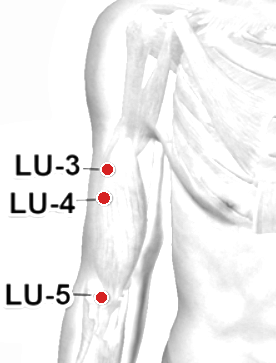
Location

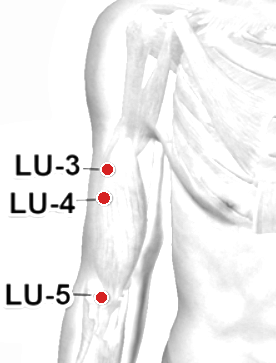
Location of LU-3 (Tianfu)

Actions

  • Promotes the descending of Lung-Qi
  • Regulates the ascending and descending of Qi (especially to/from the head)
  • Stops bleeding
  • Opens the Mind's orifices and soothes the Corporeal Soul (Po)
Key point: A Window of Heaven point — its whole action is regulating Qi flow up and down through the neck to and from the head, which is why it treats cough (Qi not descending) and insomnia/forgetfulness (Qi not properly reaching the head) via the same mechanism.

Indications

Respiratory

Cough, wheezing, breathlessness.

Mental / Head

Somnolence, insomnia, sadness, weeping, forgetfulness, goitre.

Bleeding

Epistaxis, coughing of blood (“upward” bleeding only).

Unusual

“Talking to ghosts” — a classical sign of serious mental-emotional disturbance.

Clinical Pearls (summarized from Comments)

  • Insomnia = Qi rising too much to (or not descending from) the head; somnolence/forgetfulness = clear Qi failing to rise to the head.
  • Stops only “upward” bleeding (nosebleed, coughing blood) by subduing rebellious Qi.
  • “Talking to ghosts” and similar classical indications flag it for serious Mind-obstruction conditions such as manic depression or psychosis.
  • Name contrast: LU-1 “Central Palace” (chest/Middle Burner focus) vs. LU-3 “Heavenly Palace” (head focus).

LU-5

Chize "Foot Marsh"
Lung ChannelSea (He) PointWater PointDrainage Point

Location

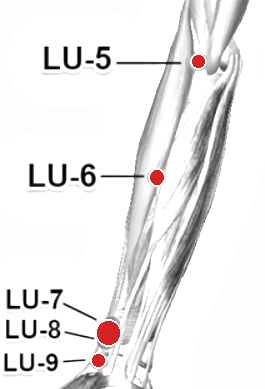
Location of LU-5 (Chize)

Actions

  • Clears Lung-Heat
  • Promotes the descending of Lung-Qi
  • Resolves Phlegm from the Lungs
  • Regulates the Water passages and benefits the Bladder
  • Relaxes the sinews
Key point: The go-to point for Excess Heat in the Lungs with Phlegm (chronic-bronchitis-type presentations) — though the author notes it can also, less classically, treat Excess-Cold Phlegm patterns (reducing method either way).

Indications

Respiratory / Heat

Tidal fever, dry mouth and tongue, agitation and fullness of the chest, cough, wheezing, breathlessness, cough with profuse phlegm.

Urinary

Oedema of limbs, enuresis, frequent urination, retention of urine.

Musculoskeletal

Pain in the upper arm and shoulder, inability to raise the arm, Wind Bi of the elbow, swelling and pain of the knee.

Clinical Pearls (summarized from Comments)

  • Combine with ST-40 for chronic Phlegm-Heat, or with KI-6 when Lung-Heat has damaged the Body Fluids.
  • Opens the Water passages - used for enuresis/frequent urination (reinforcing) or urinary retention from Damp-Phlegm obstruction (reducing, combined with SP-9 and Ren-3).
  • Relaxes the sinews along the channel - arm/shoulder Bi Syndrome, inability to raise the arm.

LU-6

Kongzui "Convergence Hole"
Lung ChannelAccumulation (Xi) Point

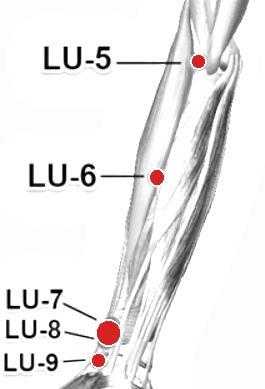
Location

Location of LU-6 (Kongzui)

Actions

  • Regulates Lung-Qi in the channel
  • Promotes the descending of Lung-Qi
  • Clears Heat
  • Stops bleeding
Key point: The Accumulation (Xi) point of the Lung channel — first choice for an acute asthma attack, consistent with how Xi points generally handle acute Excess flare-ups and stop bleeding.

Indications

Respiratory / Acute

Chest pain, swelling and pain of the throat, cough, wheezing, breathlessness, Heat syndromes of the Lungs without sweating.

Bleeding

Coughing of blood, vomiting of blood.

Musculoskeletal

Pain in the elbow and upper arm, inability to raise the arm, difficulty flexing and extending the fingers.

Clinical Pearls (summarized from Comments)

  • Also useful for channel pain along the Lung channel (elbow, upper arm) - the typical Xi-point channel action.

LU-7

Lieque "Branching Cleft"
Lung ChannelConnecting (Luo) PointOpening Point — Directing Vessel (Ren Mai)Ma Dan Yang Heavenly Star Point

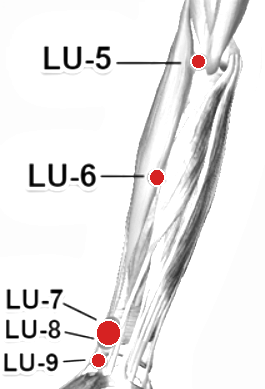
Location

Location of LU-7 (Lieque)

Actions

  • Promotes the descending and diffusing of Lung-Qi
  • Releases the Exterior, expels exterior Wind
  • Opens the Directing Vessel
  • Benefits the Bladder, opens Water passages
  • Benefits the head and neck
  • Opens the nose
  • Communicates with the Large Intestine channel
Key point: One of the most important points in the entire body — a Confluent point of the Ren Mai and the “Guest-Host” partner of L.I.-4 for releasing the Exterior, giving it an enormous range: exterior colds, chronic cough/asthma, headaches, emotional release, gynaecological issues, and Deficient-type constipation in the elderly.

Indications

Respiratory / Exterior

Cough, wheezing, breathlessness, sneezing, aversion to cold and fever.

Reproductive / Genital

Retention of lochia or dead fetus, postpartum aphasia, pain in the penis or external genitalia, nocturnal emissions.

Urinary

Blood in the urine, painful or difficult urination.

Head

Headache, stiffness and pain of the neck, deviation of eye and mouth, toothache.

Mental

Poor memory, palpitations, propensity to inappropriate laughter, frequent yawning.

Nose

Nasal polyps, nasal congestion and discharge.

Clinical Pearls (summarized from Comments)

  • “Guest-Host” combination with L.I.-4 Hegu - the classic pair for exterior Wind-Cold or Wind-Heat.
  • Paired with L.I.-20 for nasal symptoms and allergic rhinitis.
  • Emotionally: releases repressed grief, worry or sadness held by the Corporeal Soul (Po) - patients may cry during or after treatment; especially useful for those who bear problems in silence.
  • Paired with its coupled Extraordinary Vessel point KI-6 to open the Ren Mai: nourishes Yin, helps chronic asthma from Lung-Kidney deficiency, dry sore throat from Yin deficiency, and menstrual regulation.
  • Also treats Deficient-type constipation in the elderly, when weak Lung-Qi fails to power defecation via its Large Intestine connection.
  • Often paired contralaterally with ST-40 to resolve Phlegm and open the chest.
  • Compare with LU-9: LU-7 favours Exterior/Excess/acute/emotional and channel problems, where LU-9 favours Interior/Deficiency/chronic conditions.

LU-8

Jingqu "River Point Ditch"
Lung ChannelRiver (Jing-River) PointMetal Point

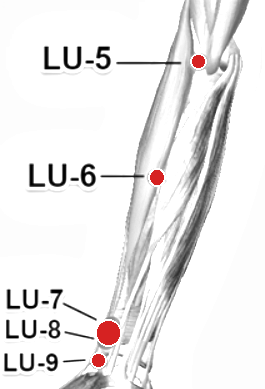
Location

Location of LU-8 (Jingqu)

Actions

  • Promotes the descending of Lung-Qi
Key point: A relatively narrow-focus point — usually added alongside other points for chronic throat/lung problems rather than used as a primary point on its own.

Indications

Respiratory

Cough, wheezing, breathlessness, distension and pain in the chest, febrile disease without sweating.

Clinical Pearls (summarized from Comments)

  • Name properly means “ditch of the River point” - “Jing” here refers to the River point of the Five Transporting points, not to “channel”.

LU-9

Taiyuan "Supreme Abyss"
Lung ChannelSource (Yuan) & Stream (Shu) PointEarth PointGathering (Hui) Point — Blood VesselsTonification Point

Location

Location of LU-9 (Taiyuan)

Actions

  • Resolves Phlegm
  • Promotes the descending of Lung-Qi and stops cough
  • Tonifies Lung-Qi and Lung-Yin
  • Tonifies Gathering Qi (Zong Qi)
  • Promotes the circulation of Blood and influences the pulse
  • Clears Lung- and Liver-Heat
Key point: The main point to tonify Lung-Qi and Lung-Yin in chronic deficiency, and — as the Gathering (Hui) point for all blood vessels — the literal reason the radial pulse is taken at this exact location.

Indications

Respiratory

Cough with expectoration of sputum, feeling of oppression of the chest, wheezing, breathlessness.

Pulse

Absence of pulse or a very feeble pulse.

Clinical Pearls (summarized from Comments)

  • Combine with Ren-17 to tonify Gathering Qi (Zong Qi) - good for Qi deficiency with cold hands and a weak voice.
  • Influences all blood vessels - used for poor circulation, cold hands/feet, chilblains, varicose veins.
  • Indirectly tonifies Heart-Qi and Blood too, via the Lung-Heart relationship - breathlessness on exertion, listlessness, palpitations.
  • Compare with LU-7: LU-9 favours Interior/Deficiency/chronic conditions and affects Qi and Blood, where LU-7 favours Exterior/Excess/acute conditions and affects Qi only.

LU-10

Yuji "Fish Border"
Lung ChannelSpring (Ying) PointFire Point

Location

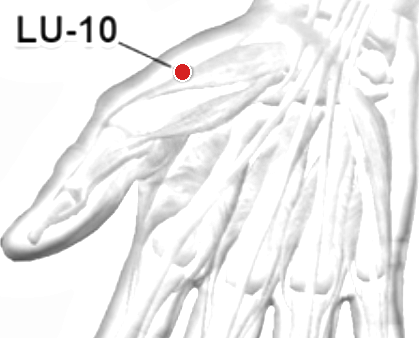
Location of LU-10 (Yuji)

Actions

  • Clears Lung-Heat
  • Promotes the descending of Lung-Qi and stops cough
  • Benefits the throat
  • Calms the Mind
Key point: The main point for clearing Lung-Heat in acute situations (vs. LU-5, which clears Heat combined with Phlegm) — works for both Full-Heat and Empty-Heat presentations.

Indications

Heat

Feeling of heat, dry throat, cough, breathlessness.

Throat

Painful obstruction of the throat, sore throat, dry throat.

Mental

Sadness, fear, mental restlessness, anger, manic behaviour, fright.

Clinical Pearls (summarized from Comments)

  • For sore throat from Heat or Wind-Heat; combine with KI-6 for sore throat from Yin deficiency (not used alone for that).
  • Also clears Heart-Heat - treats fear, mental restlessness, anger, manic behaviour, fright.

LU-11

Shaoshang "Lesser Metal"
Lung ChannelWell (Jing) PointWood Point

Location

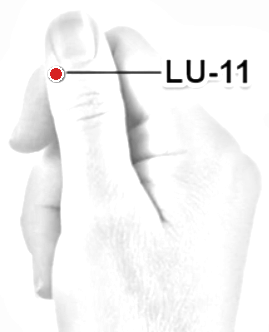
Location of LU-11 (Shaoshang)

Actions

  • Expels exterior Wind
  • Stimulates the diffusing and descending of Lung-Qi
  • Benefits the throat
  • Extinguishes interior Wind, opens the orifices and promotes resuscitation
Key point: Classically bled (not just needled) for acute sore throat and swollen tonsils from Wind-Heat — and, combined with the other hand Well points, part of the emergency protocol for resuscitation after Wind-stroke.

Indications

Exterior

Aversion to cold, fever, cough, breathlessness.

Throat

Sore throat, painful obstruction of the throat, swollen tonsils, mumps.

Emergency

Loss of consciousness from Wind-stroke.

Clinical Pearls (summarized from Comments)

  • Name means “Lesser Metal” (not the more common “Lesser Merchant”) - “Metal” here is one of the Five-Element correspondence sounds, matching the Lung's Metal element.