Logout πŸ“Š Admin
🏠 Home
Kidney Channel β€” Teaching Deck (21 points)

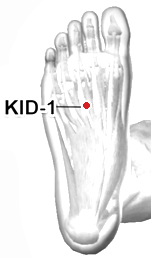
KI-1

Yongquan "Bubbling Spring"
Kidney ChannelWell (Jing) PointWood PointDrainage Point

Location

Location of KI-1 (Yongquan)

Actions

  • Nourishes Yin and clears Empty-Heat
  • Regulates the Lower Burner
  • Extinguishes interior Wind
  • Calms the Mind
  • Restores consciousness
Key point: Despite being on the Kidney (Yin) channel, KI-1 has a marked reducing/draining effect β€” used in Excess patterns, resuscitation, and to bring rebellious Yang or Wind down from the head; its location on the sole gives it a uniquely strong β€œsinking” action.

Indications

Yin Deficiency

Dry tongue, dry throat, dizziness, tinnitus, night sweating.

Digestive / Urinary

Constipation, difficult urination, abdominal fullness, umbilical pain, infertility, impotence.

Neurological

Epilepsy, headache, vertigo.

Mental

Agitation, insomnia, poor memory, fear, rage, manic behaviour.

Emergency

Unconsciousness from Wind-stroke.

Clinical Pearls (summarized from Comments)

  • Nourishes Yin and clears Empty-Heat - used for the pattern of Heart and Kidney not harmonized.
  • A strong calming effect for severe anxiety or mental illness such as hypomania.
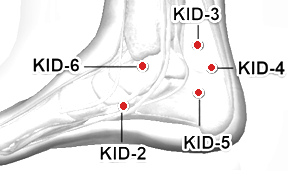
KI-2

Rangu "Blazing Valley"
Kidney ChannelSpring (Ying) PointFire PointBeginning Point β€” Yin Stepping Vessel (Yin Qiao Mai)

Location

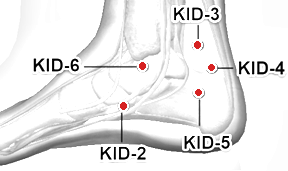
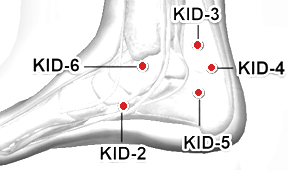
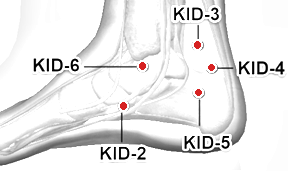
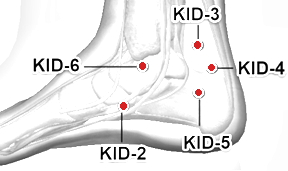
Location of KI-2 (Rangu)

Actions

  • Clears Empty-Heat and cools Blood
  • Invigorates the Yin Stepping Vessel (Yin Qiao Mai)
Key point: The main point to clear Empty-Heat from the Kidneys specifically (malar flush, five-palm heat, evening heat, night sweating) β€” can be combined with LU-10 for Lung Empty-Heat or HE-6 for Heart Empty-Heat.

Indications

Yin Deficiency

Dry throat, night sweating, feeling of heat in the evening, five-palm heat, malar flush.

Gynaecological / Urinary

Itching of genitals, infertility, irregular menstruation, difficult urination, unilateral abdominal pain, abdominal masses.

Clinical Pearls (summarized from Comments)

  • As the Yin Stepping Vessel's beginning point, also moves Qi and Blood in that vessel - used for unilateral abdominal pain and abdominal masses.

KI-3

Taixi "Greater Stream"
Kidney ChannelStream (Shu) & Source (Yuan) PointEarth Point

Location

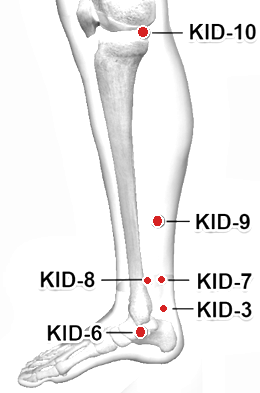
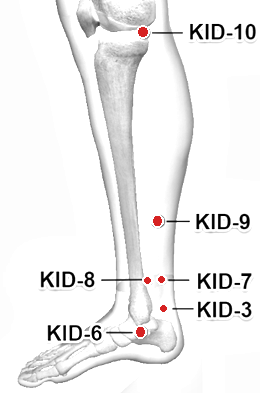
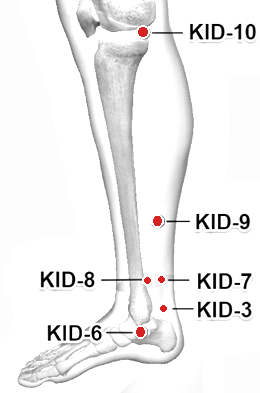
Location of KI-3 (Taixi)

Actions

  • Tonifies the Kidneys (both Yin and Yang)
  • Strengthens the Kidney's receiving of Qi
  • Calms the Mind
  • Benefits the Essence
  • Strengthens the lower back and knees
  • Regulates the uterus
Key point: The main point to tonify the Kidneys in any deficiency β€” Yin, Yang, Qi, Essence, and reception of Qi all at once; whether moxa is used determines if Yang or Yin predominates.

Indications

Constitutional

Backache, dizziness, tinnitus, exhaustion, feeling cold, frequent urination, cold and weak knees.

Yin Deficiency

Dry throat, night sweating, hot palms.

Respiratory / Mental

Cough, wheezing, breathlessness, insomnia, excessive dreaming, poor memory.

Reproductive

Seminal or nocturnal emissions, impotence, premature ejaculation, irregular periods, infertility.

Clinical Pearls (summarized from Comments)

  • One of the three core Kidney-tonifying points, together with BL-23 and Ren-4.
  • Regulates the Uterus via its effect on Essence.
  • Used to treat any type of chronic lower backache.

KI-4

Dazhong "Big Bell"
Kidney ChannelConnecting (Luo) Point

Location

Location of KI-4 (Dazhong)

Actions

  • Strengthens the Kidney's receiving of Qi
  • Calms and lifts the Mind
  • Benefits urination
  • Strengthens the back
Key point: Via its Luo connection to the Bladder channel, especially useful for chronic backache from Kidney deficiency, combined with Governing Vessel points.

Indications

Respiratory

Cough, coughing of blood, wheezing, breathlessness, rattling sound in the throat, chest oppression.

Mental

Palpitations, agitation, mental retardation, manic behaviour, propensity to anger, somnolence, fright, unhappiness, desire to close doors and remain at home.

Urinary

Difficult urination, dribbling or retention of urine.

Clinical Pearls (summarized from Comments)

  • The indication β€œdesire to close doors and remain at home” is a vivid classical description of withdrawal and depression from Kidney-related mental disturbance.

KI-5

Shuiquan "Water Spring"
Kidney ChannelAccumulation (Xi) Point

Location

Location of KI-5 (Shuiquan)

Actions

  • Benefits urination
  • Regulates the uterus and menstruation
Key point: As an Xi point, used acutely β€” cystitis or urethritis, umbilical pain, and specifically amenorrhoea from Kidney deficiency.

Indications

Urinary

Difficult urination, dribbling of urine.

Gynaecological

Scanty periods, amenorrhoea, irregular menstruation, painful periods, prolapse of uterus.

Clinical Pearls (summarized from Comments)

    KI-6

    Zhaohai "Shining Sea"
    Kidney ChannelOpening Point β€” Yin Stepping Vessel (Yin Qiao Mai)

    Location

    Location of KI-6 (Zhaohai)

    Actions

    • Nourishes Kidney-Yin
    • Benefits the eyes
    • Calms the Mind
    • Invigorates the Yin Stepping Vessel
    • Benefits the throat
    • Regulates the uterus and menstruation
    Key point: The best point on the Kidney channel to nourish Kidney-Yin and moisten dryness β€” uniquely directs Yin energy specifically up to the eyes and throat via the Yin Stepping Vessel.

    Indications

    Yin Deficiency

    Dizziness, tinnitus, night sweating, backache, dry eyes, dry throat, dry cough.

    Eyes / Mental

    Blurred vision, red eyes, floaters, insomnia, somnolence, sadness, fright, nightmares.

    Genital / Muscular

    Itching of genitals, involuntary erection, hypogastric pain, tightness of the inner leg muscles, foot cramps, hemiplegia.

    Gynaecological

    Irregular periods, amenorrhoea, painful periods, infertility from Cold in the Uterus, difficult labour.

    Clinical Pearls (summarized from Comments)

    • Combined with BL-62 for insomnia: reinforce KI-6, reduce BL-62 (reverse for somnolence).
    • Calms the Mind by nourishing Yin - anxiety and restlessness from Yin deficiency.
    • Cools Blood - used in skin diseases characterized by Heat in the Blood.
    • Treats epilepsy specifically with night-time attacks (vs. BL-62 for daytime attacks).

    KI-7

    Fuliu "Returning Current"
    Kidney ChannelRiver (Jing-River) PointMetal PointTonification Point

    Location

    Location of KI-7 (Fuliu)

    Actions

    • Tonifies the Kidneys
    • Resolves Dampness
    • Opens the Water passages of the Lower Burner and resolves oedema
    • Strengthens the lower back
    • Regulates sweating
    Key point: Tonifies the Kidneys similarly to KI-3, but the author's clinical view is that it is better specifically for Kidney-Yang β€” an ongoing debate in the literature, supported here by its oedema-resolving action.

    Indications

    Constitutional

    Backache, dizziness, tinnitus, weak knees, tiredness.

    Digestive

    Diarrhoea, abdominal fullness, mucus and blood in the stools, borborygmi.

    Urinary / Fluid

    Oedema, difficult urination, retention of urine, painful or turbid urine.

    Sweating

    Sweating or night sweating.

    Clinical Pearls (summarized from Comments)

    • Can promote or stop sweating depending on technique - reduce (combined with L.I.-4) to promote sweating in exterior Wind-Cold; reinforce (combined with HE-6) to stop night sweating from Kidney-Yin deficiency.

    KI-8

    Jiaoxin "Meeting the Spleen Channel"
    Kidney ChannelAccumulation (Xi) Point β€” Yin Stepping Vessel (Yin Qiao Mai)

    Location

    Location of KI-8 (Jiaoxin)

    Actions

    • Benefits the Uterus and regulates menstruation
    • Resolves Dampness
    • Removes obstructions from the channel
    Key point: As the Yin Stepping Vessel's own Xi point, particularly good at dissolving abdominal masses (especially Zheng Jia in women) and treating menstrual problems from Blood stasis.

    Indications

    Gynaecological

    Painful, heavy or irregular periods, amenorrhoea.

    Digestive / Urinary

    Abdominal fullness, diarrhoea, retention of urine, painful or turbid urine, swelling and pain of testicles, itching of genitals.

    Other

    Unilateral abdominal pain, abdominal masses.

    Clinical Pearls (summarized from Comments)

      KI-9

      Zhubin "Guest House"
      Kidney ChannelAccumulation (Xi) Point β€” Yin Linking Vessel (Yin Wei Mai)

      Location

      Location of KI-9 (Zhubin)

      Actions

      • Calms the Mind and opens the Mind's orifices
      • Tonifies Kidney-Yin
      • Opens the chest
      • Regulates the Yin Linking Vessel
      Key point: An excellent point to calm deep anxiety and mental restlessness from Kidney-Yin deficiency, in the pattern of Heart and Kidneys not harmonized β€” its name (β€œGuest House”) reflects the Heart as guest, hosted by the Kidneys.

      Indications

      Mental

      Anxiety, insomnia, palpitations, manic behaviour.

      Constitutional

      Backache, dizziness, tinnitus, night sweating, dry throat.

      Chest

      Feeling of stuffiness under the xiphoid process, oppression of the chest.

      Clinical Pearls (summarized from Comments)

      • Combine with the Yin Linking Vessel's opening points, P-6 and SP-4, since KI-9 is that vessel's own starting/Xi point.

      KI-10

      Yingu "Yin Valley"
      Kidney ChannelSea (He) PointWater Point

      Location

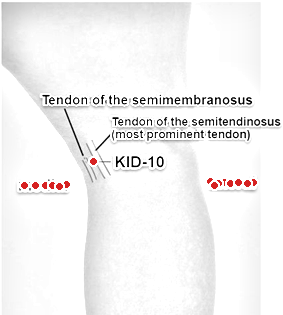
      Location of KI-10 (Yingu)

      Actions

      • Resolves Dampness from the Lower Burner
      • Tonifies Kidney-Yin
      Key point: One of the three Yin knee Sea points (with SP-9 and LIV-8) for resolving Lower Burner Dampness, plus nourishes Kidney-Yin β€” distinguished from KI-6 (Yin to eyes/throat) and KI-9 (Yin for emotional problems) by its more general, physical Yin-nourishing role.

      Indications

      Urinary

      Hypogastric pain and fullness, abdominal distension and pain, difficult, turbid or painful urination.

      Constitutional

      Backache, tinnitus, deafness, night sweating, dark urine, dry throat.

      Clinical Pearls (summarized from Comments)

        KI-11

        Henggu "Pubic Bone"
        Kidney ChannelPoint of the Penetrating Vessel (Chong Mai)

        Location

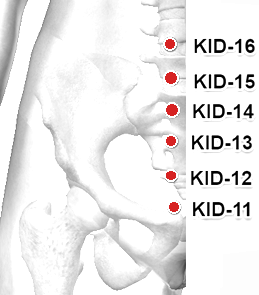
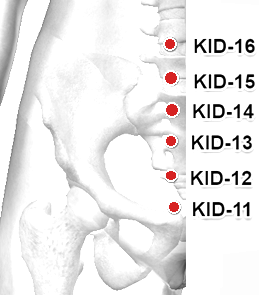
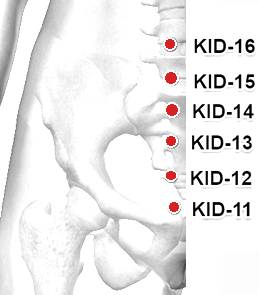
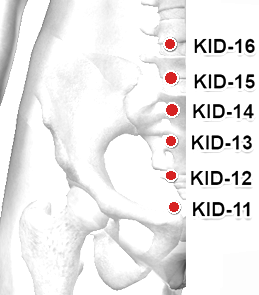
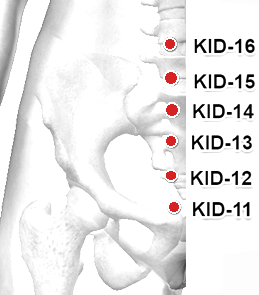
        Location of KI-11 (Henggu)

        Actions

        • Resolves Dampness
        • Moves Qi and Blood in the Lower Burner
        • Clears Heat
        Key point: The first Kidney-channel point on the abdominal Penetrating Vessel pathway (right after it emerges at ST-30) β€” inherits a uniquely dynamic, forceful Qi/Blood-moving quality from this position.

        Indications

        Urinary / Genital

        Difficulty urinating, retention of urine, hypogastric fullness, genital pain, lower abdominal pain.

        Eyes

        Inner canthus of eyes red and painful.

        Clinical Pearls (summarized from Comments)

        • Like other Penetrating Vessel abdominal points, also reaches the eyes via the Vessel's pathway.

        KI-12

        Dahe "Big Glory"
        Kidney ChannelPoint of the Penetrating Vessel (Chong Mai)

        Location

        Location of KI-12 (Dahe)

        Actions

        • Tonifies the Kidneys
        • Benefits the Essence
        • Regulates the Uterus and menstruation
        • Clears Heat
        Key point: The point where Essence classically β€œconcentrates”, and where, per traditional embryology, the uterus's first enlargement in pregnancy manifests β€” combined with Ren-3 and SP-6 to promote ovulation.

        Indications

        Constitutional

        Backache, tinnitus, deafness, night sweating, dry throat and eyes.

        Reproductive

        Impotence, seminal emissions, prolapse of uterus, irregular or painful periods, infertility.

        Clinical Pearls (summarized from Comments)

        • Used to promote ovulation at the start of the third phase of the menstrual cycle, combined with Ren-3 and SP-6.

        KI-13

        Qixue "Qi Hole"
        Kidney ChannelPoint of the Penetrating Vessel (Chong Mai)Meeting Point (Liver β€’ Spleen)

        Location

        Location of KI-13 (Qixue)

        Actions

        • Tonifies the Kidneys and Essence
        • Strengthens the Uterus and consolidates the Penetrating and Directing Vessels
        • Moves Qi and Blood
        • Regulates the two lower orifices
        • Clears Heat
        Key point: A genuinely dual-function point β€” a powerful Kidney_pencil_sketch/Essence tonic on one hand, and a treatment for Excess-pattern Running Piglet Syndrome (rebellious Penetrating Vessel Qi surging from the lower abdomen to the chest and throat) on the other.

        Indications

        Constitutional

        Backache, tinnitus, deafness, weak knees.

        Gynaecological / Reproductive

        Amenorrhoea, irregular periods, excessive menstrual bleeding, infertility, impotence.

        Abdominal

        Abdominal pain, Running Piglet Syndrome, urinary difficulty, diarrhoea.

        Clinical Pearls (summarized from Comments)

        • Combine with Ren-4 for chronic asthma, via strengthening the Kidney's reception of Qi.
        • Important for consolidating the Penetrating and Directing Vessels in excessive menstrual bleeding.

        KI-14

        Siman "Four Fullnesses"
        Kidney ChannelPoint of the Penetrating Vessel (Chong Mai)

        Location

        Location of KI-14 (Siman)

        Actions

        • Moves Qi and Blood in the lower abdomen
        • Regulates the Uterus and menstruation
        • Nourishes Essence and Marrow
        Key point: The main Penetrating Vessel point to invigorate Blood in the lower abdomen and Uterus β€” The author's point of choice (with ST-28) for uterine myomas and (with ST-29) for endometriosis, both Blood-stasis conditions.

        Indications

        Abdominal

        Lower abdominal pain, umbilical pain, constipation, Running Piglet Syndrome.

        Gynaecological

        Painful periods, excessive menstrual bleeding, irregular periods, retention of lochia, excessive vaginal discharge, infertility.

        Clinical Pearls (summarized from Comments)

        • Also nourishes Essence and Marrow, though used more often in practice for Excess Blood-stasis patterns.

        KI-16

        Huangshu "Transporting Point of Huang"
        Kidney ChannelPoint of the Penetrating Vessel (Chong Mai)

        Location

        Location of KI-16 (Huangshu)

        Actions

        • Tonifies the Kidneys
        • Benefits the Membranes (Huang)
        • Benefits the Heart
        • Moves Qi and Blood in the abdomen
        • Regulates the Intestines
        Key point: Connected to the β€œGaohuang” region (between heart and diaphragm) via Kidney-Qi's upward pathway β€” the abdominal-line counterpart to BL-17 Geshu on the back, able to harmonize Kidneys and Heart simultaneously.

        Indications

        Constitutional

        Backache, tinnitus, deafness, tiredness, weak knees.

        Digestive

        Abdominal distension and pain, umbilical pain, constipation, diarrhoea, Cold in the Large Intestine.

        Clinical Pearls (summarized from Comments)

        • Calms the Heart and relieves anxiety from rebellious Penetrating Vessel Qi.
        • Useful when Kidney-Yin fails to nourish the Heart.

        KI-17

        Shangqu "Bent Metal"
        Kidney ChannelPoint of the Penetrating Vessel (Chong Mai)

        Location

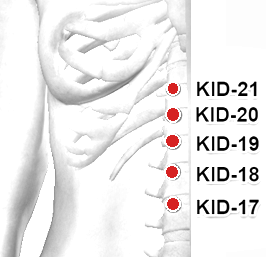
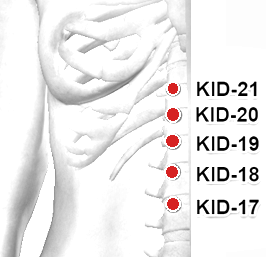
        Location of KI-17 (Shangqu)

        Actions

        • Regulates the Spleen, harmonizes the Stomach and dissolves accumulation
        Key point: A local point for the Large Intestine specifically β€” its name references the bend between the ascending and transverse colon.

        Indications

        Digestive

        Constipation, diarrhoea, abdominal masses, abdominal fullness and pain, difficulty swallowing, nausea and vomiting.

        Clinical Pearls (summarized from Comments)

          KI-21

          Youmen "Door of Darkness"
          Kidney ChannelPoint of the Penetrating Vessel (Chong Mai)

          Location

          Location of KI-21 (Youmen)

          Actions

          • Harmonizes the Stomach
          • Subdues rebellious Qi and stops vomiting
          • Benefits the breasts
          • Moves Qi in the chest
          Key point: The point where the Penetrating Vessel leaves its superficial pathway to disperse into the chest and breasts β€” subdues rebellious Stomach-Qi and moves Qi in the chest and breasts.

          Indications

          Digestive

          Vomiting of foamy saliva, hiccup, sour regurgitation, retching, nausea and vomiting in pregnancy, epigastric fullness, poor appetite.

          Chest / Breast

          Breast distension and pain, milk not flowing, chest pain, hypochondrial distension, cough.

          Clinical Pearls (summarized from Comments)

          • Combine with ST-19 for nausea and vomiting.
          • Combine with its opening points, SP-4 and P-6, plus KI-13 or KI-14, for rebellious Penetrating Vessel Qi, depending on whether the condition is Full or Full-Empty.

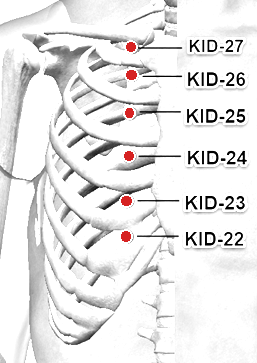
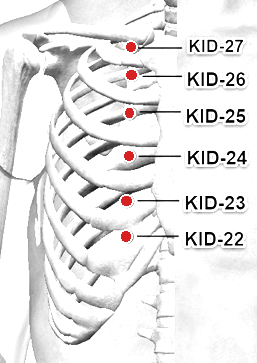
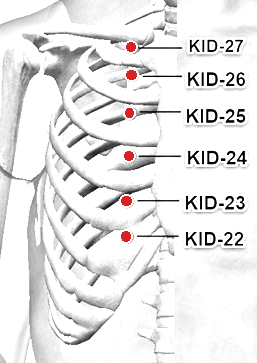
          KI-23

          Shenfeng "Mind Seal"
          Kidney ChannelNo special Five-Element classification

          Location

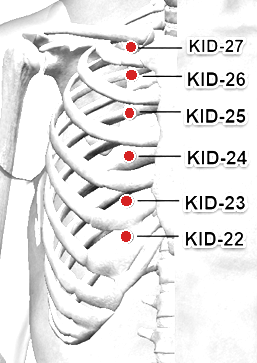
          Location of KI-23 (Shenfeng)

          Actions

          • Opens the chest and stops cough
          • Harmonizes the Stomach and subdues rebellious Qi
          • Benefits the breasts
          Key point: A local chest point harmonizing the Lungs and Kidneys - promoting Lung-Qi's descent and the Kidney's reception of Qi - used for breathing problems and rebellious Stomach-Qi.

          Indications

          Respiratory

          Tightness of the chest, cough, wheezing, breathlessness, hypochondrial distension and fullness.

          Digestive

          Nausea, vomiting, difficulty swallowing, poor appetite.

          Breast

          Breast distension and pain, breast abscess.

          Clinical Pearls (summarized from Comments)

            KI-24

            Lingxu "Spirit Burial Ground"
            Kidney ChannelNo special Five-Element classification

            Location

            Location of KI-24 (Lingxu)

            Actions

            • Promotes the free flow of Liver-Qi
            • Opens the chest and promotes the descending of Lung-Qi
            Key point: Same Lung-Kidney harmonizing role as KI-23, plus an added ability to move Liver-Qi in the chest and hypochondrium.

            Indications

            Chest

            Distension and pain of the hypochondrium.

            Respiratory

            Cough, wheezing, breathlessness.

            Clinical Pearls (summarized from Comments)

              KI-25

              Shencang "Mind Storage"
              Kidney ChannelNo special Five-Element classification

              Location

              Location of KI-25 (Shencang)

              Actions

              • Opens the chest and promotes the descending of Lung-Qi
              • Subdues rebellious Stomach-Qi
              Key point: Same Lung-Kidney harmonizing role as KI-23/KI-24, plus subdues rebellious Stomach-Qi for nausea and vomiting.

              Indications

              Respiratory

              Cough, wheezing, breathlessness, chest pain.

              Digestive

              Nausea, vomiting, difficulty swallowing, poor appetite.

              Clinical Pearls (summarized from Comments)

                KI-27

                Shufu "Transporting Point Mansion"
                Kidney ChannelNo special Five-Element classification

                Location

                Location of KI-27 (Shufu)

                Actions

                • Promotes the descending of Lung-Qi and stops cough
                • Harmonizes the Stomach and stops vomiting
                Key point: An important local point for asthma from Kidney deficiency, completing the sequence of upper-chest Kidney points (KI-23/24/25/27) that all share this Lung-Kidney harmonizing role.

                Indications

                Respiratory

                Cough, wheezing, breathlessness, chest pain.

                Digestive

                Nausea, vomiting, poor appetite.

                Clinical Pearls (summarized from Comments)