Logout πŸ“Š Admin
🏠 Home
Ren Mai (Directing Vessel) β€” Teaching Deck (19 points)

REN-1

Huiyin "Meeting of Yin"
Ren Mai (Directing Vessel)Beginning point of Ren Mai, Chong Mai and Du MaiSun Si Miao Ghost Point

Location

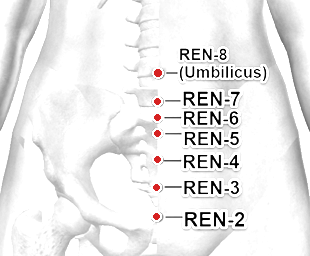
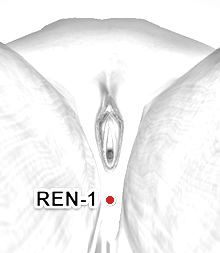
Location of REN-1 (Huiyin)

Actions

  • Regulates the two lower orifices and genitalia and resolves Dampness
  • Promotes resuscitation
  • Calms the Mind and opens the Mind's orifices
  • Nourishes Yin
Key point: The point where Ren Mai, Du Mai and Chong Mai all emerge from the Interior β€” a dynamic point for moving Qi and Blood and subduing rebellious Qi, with some indications (epilepsy, manic depression, haemorrhoids) really reflecting Governing Vessel pathology.

Indications

Genitourinary

Difficult urination and defecation, enuresis, impotence, pain in penis, sweating of genitals, swelling of testicles/vulva/vagina, prolapse of rectum, haemorrhoids, itching and pain of perineum.

Mental / Emergency

Coma or unconsciousness from drowning; manic depression.

Clinical Pearls (summarized from Comments)

  • As one of Sun Si Miao's Ghost points, calms the Mind and opens its orifices in manic depression.
  • Nourishes Yin and Kidney-Essence β€” used for incontinence, enuresis and nocturnal emissions from Yin deficiency.
REN-2

Qugu "Curved Bone"
Ren Mai (Directing Vessel)Meeting point (Ren Mai β€’ Liver)

Location

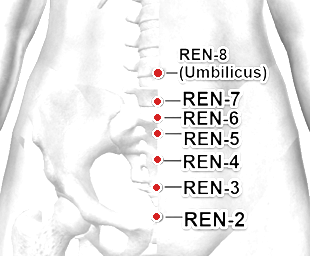
Location of REN-2 (Qugu)

Actions

  • Benefits the Bladder and regulates urination
  • Consolidates the Essence
  • Strengthens the Kidneys and the Essence
Key point: A good alternative to REN-1 for urination and Dampness, but with more of a "firming" action on the Essence β€” the point of choice for seminal emissions, premature ejaculation and chronic vaginal discharge.

Indications

Genitourinary

Dribbling or difficult urination, retention of urine, enuresis, itchy scrotum, contraction of penis, pain in genitalia, vaginal itching.

Essence

Seminal emissions, premature ejaculation, chronic vaginal discharge, impotence, exhaustion of the five Yin organs.

Clinical Pearls (summarized from Comments)

    REN-3

    Zhongji "Middle Pole"
    Ren Mai (Directing Vessel)Front Collecting (Mu) Point β€” BladderMeeting point (Ren Mai β€’ Spleen β€’ Liver β€’ Kidneys)Meeting point of the three Yin leg channels

    Location

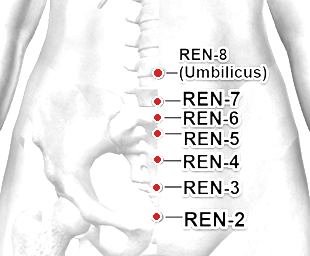
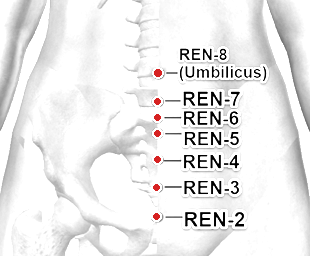
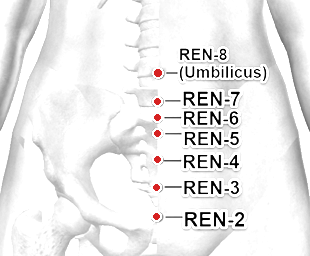
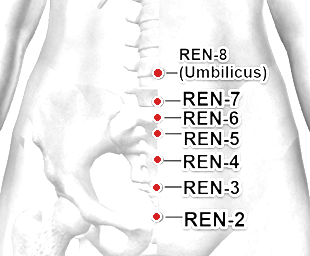
    Location of REN-3 (Zhongji)

    Actions

    • Resolves Dampness from the Lower Burner
    • Promotes the Bladder's Qi transformation
    • Benefits the Uterus and regulates menstruation
    • Strengthens the Kidneys and nourishes the Essence
    Key point: The main point for the Bladder's Qi-transformation function β€” used more with reducing method in acute/Excess urinary problems, and specific for Damp-Heat of the Bladder (combine with SP-6, SP-9 or LIV-5). The author favours REN-4 over REN-3 for Deficiency patterns.

    Indications

    Genitourinary

    Genital itching and pain, excessive vaginal discharge, retention of urine, frequent urination, dark urine, pain on urination.

    Gynaecological

    Infertility, irregular periods, amenorrhoea, excessive uterine bleeding, abdominal masses, retention of placenta or lochia.

    Kidney / Constitutional

    Lower backache, dizziness, tinnitus, weak knees, deficiency of Original Qi.

    Clinical Pearls (summarized from Comments)

      REN-4

      Guanyuan "Gate to the Original Qi"
      Ren Mai (Directing Vessel)Front Collecting (Mu) Point β€” Small IntestineMeeting point (Ren Mai β€’ Spleen β€’ Liver β€’ Kidneys)Meeting point of Ren Mai and Chong Mai

      Location

      Location of REN-4 (Guanyuan)

      Actions

      • Nourishes Blood and Yin
      • Strengthens the Kidneys
      • Strengthens the Uterus and regulates menstruation
      • Benefits Original Qi
      • Benefits the Bladder
      • Subdues rebellious Qi in the Penetrating Vessel
      • Regulates the Small Intestine
      • Strengthens the Kidney's receiving of Qi
      • Roots the Mind and the Ethereal Soul
      Key point: Probably the most important tonic point in the body β€” tonifies Qi, Blood, Yin, Yang, Essence and Original Qi all at once. With direct moxa it rescues collapsed Yang; without, it's the main point for the Uterus/menstruation and a powerful calmer of anxiety by rooting Qi downward.

      Indications

      Kidney / Constitutional

      Lower backache, weak knees, dizziness, tinnitus, feeling of cold in the back, dark face, frequent urination, impotence.

      Gynaecological

      Infertility, cold sensation in the vagina, amenorrhoea, bleeding in pregnancy, persistent lochial discharge.

      Bladder

      Retention of urine, dark or painful urination, blood in the urine.

      Penetrating Vessel

      Cold in the lower abdomen, Running Piglet Syndrome, abdominal fullness, umbilical pain.

      Intestines / Lungs / Mind

      Diarrhoea with undigested food; cough, coughing of blood, breathlessness; fear, fright, insomnia.

      Clinical Pearls (summarized from Comments)

      • Compared with REN-3: REN-3 affects the Bladder and is mostly reducing/Excess-pattern work; REN-4 affects the Uterus, has a much stronger general tonic effect, and calms the Mind β€” REN-3 does not.
      • Combine with LU-7 and KI-6 (Ren Mai opening points) for menstrual/gynaecological problems, or with SP-4 and P-6 (Chong Mai opening points) to subdue rebellious Penetrating Vessel Qi.

      REN-5

      Shimen "Stone Door"
      Ren Mai (Directing Vessel)Front Collecting (Mu) Point β€” Triple Burner

      Location

      Location of REN-5 (Shimen)

      Actions

      • Opens the Water passages and promotes fluid transformation/excretion in the Lower Burner
      • Regulates Qi in the Lower Burner
      • Regulates the Uterus
      • Strengthens Original Qi
      Key point: Rouses Original Qi (via its role as the Triple Burner's Front-Mu point) to circulate to all organs and channels β€” best for menstrual disorders complicated by Dampness in the Lower Burner or Phlegm in the Uterus, where REN-4 alone isn't specific enough.

      Indications

      Urinary / Genital

      Difficult urination, retention of urine, painful or dark urine, oedema, diarrhoea, genital itching, swelling of scrotum/vulva/penis.

      Qi Stagnation

      Twisting lower abdominal pain, Running Piglet Syndrome, umbilical pain, retraction of testicles.

      Gynaecological / Constitutional

      Persistent lochial discharge, abdominal masses, heavy periods, stone-like hardness of the lower abdomen, exhaustion.

      Clinical Pearls (summarized from Comments)

        REN-6

        Qihai "Sea of Qi"
        Ren Mai (Directing Vessel)Meeting point (Ren Mai β€’ Kidney)Meeting point of Ren Mai and Chong Mai

        Location

        Location of REN-6 (Qihai)

        Actions

        • Tonifies Qi and Yang
        • Raises sinking Qi
        • Tonifies Original Qi
        • Regulates Qi in the Lower Burner
        Key point: A major tonifying point, especially with direct moxa β€” used for extreme exhaustion and depression. Unlike REN-4 (which nourishes Blood/Yin and calms the Mind), REN-6 tonifies Qi/Yang and actively moves Qi, so it also treats stagnation-type lower abdominal pain.

        Indications

        Qi / Yang Deficiency

        Qi or Original Qi deficiency, collapse of Yang, tiredness, cold limbs, loose stools, weak voice.

        Sinking Qi

        Prolapse of uterus, profuse menstrual bleeding from Qi deficiency, chronic vaginal discharge, frequent urination or incontinence, feeling of bearing down.

        Qi Stagnation

        Hernial/genitourinary disorders, umbilical pain, abdominal pain.

        Clinical Pearls (summarized from Comments)

        • Combine with G.B.-34 to move stagnant Qi and relieve lower abdominal pain/distension.

        REN-7

        Yinjiao "Yin Crossing"
        Ren Mai (Directing Vessel)Meeting point (Ren Mai β€’ Kidney)Meeting point of Ren Mai and Chong Mai

        Location

        Location of REN-7 (Yinjiao)

        Actions

        • Regulates the Uterus and menstruation
        • Regulates the Penetrating Vessel
        • Resolves Dampness from the Lower Burner
        • Nourishes Yin
        Key point: Its dual nourish-Yin/tonify-Yang-to-resolve-Dampness action comes from being the meeting point where Original Yang and Original Yin cross β€” the author uses it often to nourish Kidney-Yin in menopausal problems.

        Indications

        Gynaecological

        Heavy, painful or irregular periods, amenorrhoea, infertility, menopausal hot flushes.

        Penetrating Vessel

        Hardness and pain of the abdomen, Running Piglet Syndrome, chest pain, hypogastric or umbilical pain.

        Dampness

        Hernial/genitourinary disorders, retraction of testicles, itching of genitals, retention of urine and faeces.

        Clinical Pearls (summarized from Comments)

          REN-8

          Shenque "Spirit Palace"
          Ren Mai (Directing Vessel)No special Five-Element classification

          Location

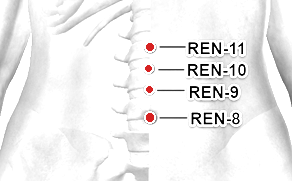
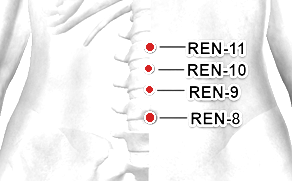
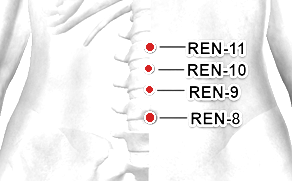
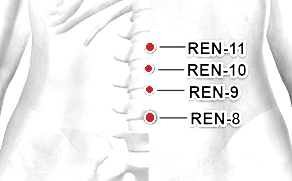
          Location of REN-8 (Shenque)

          Actions

          • Rescues Yang
          • Strengthens the Spleen
          • Tonifies Original Qi
          Key point: Never needled β€” used only with indirect moxibustion (moxa cones on a layer of salt in the navel) to rescue collapsed Yang in the flaccid stage of Wind-stroke, or for severe Kidney-Yang/Original-Qi deficiency with internal Cold.

          Indications

          Emergency

          Loss of consciousness from Wind-stroke, collapse of Yang.

          Spleen-Yang

          Cold in the abdomen, diarrhoea, borborygmi, diarrhoea in the elderly/children, prolapse of rectum.

          Constitutional

          Infertility.

          Clinical Pearls (summarized from Comments)

          • At the centre of the umbilicus β€” anatomically and energetically the point most connected to Pre-Heaven Qi, via the umbilical-cord link to the mother's Gate of Life (Ming Men).

          REN-9

          Shuifen "Water Separation"
          Ren Mai (Directing Vessel)No special Five-Element classification

          Location

          Location of REN-9 (Shuifen)

          Actions

          • Opens the Water passages and promotes fluid transformation
          Key point: A key point for promoting the separation of clear from turbid fluids (Small Intestine function) throughout the body β€” especially indicated for ascites/abdominal oedema.

          Indications

          Fluids

          Oedema (especially abdominal/ascites).

          Clinical Pearls (summarized from Comments)

          • Combine with REN-11 and ST-22 to promote fluid transformation specifically in the Middle Burner.

          REN-10

          Xiawan "Lower Epigastrium"
          Ren Mai (Directing Vessel)Meeting point (Ren Mai β€’ Spleen)

          Location

          Location of REN-10 (Xiawan)

          Actions

          • Promotes the descending of Stomach-Qi
          • Resolves stagnation of food
          Key point: One of three points controlling the epigastrium in thirds β€” REN-13 (upper, subdues rebellious Qi), REN-12 (middle, digestion itself), REN-10 (lower, moves food through the pylorus/duodenum).

          Indications

          Digestive

          Abdominal and epigastric fullness, abdominal hardness, epigastric pain, nausea, undigested food in the stools.

          Clinical Pearls (summarized from Comments)

            REN-11

            Jianli "Building Mile"
            Ren Mai (Directing Vessel)No special Five-Element classification

            Location

            Location of REN-11 (Jianli)

            Actions

            • Promotes the Stomach's rotting and ripening of food
            • Promotes the descending of Stomach-Qi
            Key point: Widely used for Stomach Excess patterns β€” fullness, nausea, vomiting, epigastric pain β€” better for Excess than Deficiency (contrast with REN-12).

            Indications

            Digestive

            Epigastric and abdominal distension, abdominal pain, vomiting.

            Clinical Pearls (summarized from Comments)

              REN-12

              Zhongwan "Middle Epigastrium"
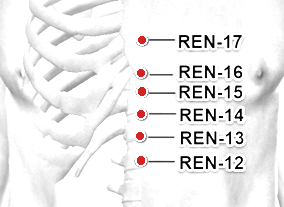
              Ren Mai (Directing Vessel)Front Collecting (Mu) Point β€” StomachGathering (Hui) Point β€” Yang organsFront Collecting (Mu) Point β€” Middle BurnerMeeting point (Ren Mai β€’ Small Intestine β€’ Triple Burner β€’ Stomach)

              Location

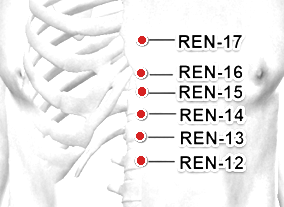
              Location of REN-12 (Zhongwan)

              Actions

              • Tonifies Stomach and Spleen
              • Resolves Dampness and Phlegm
              • Regulates Stomach-Qi
              • Calms the Mind
              Key point: The author's go-to point to tonify Stomach- and Spleen-Qi in Deficiency patterns (unlike REN-11/REN-13, which suit Excess) β€” a gentle tonic, best with moxa for Empty-Cold, and can also nourish Stomach-Yin (combine with ST-36 + SP-6) or calm emotional-strain digestive upset.

              Indications

              Spleen-Qi Deficiency

              Tiredness, loose stools, poor appetite, weak limbs, desire to lie down.

              Dampness

              Abdominal fullness, sticky taste, feeling of heaviness, nausea.

              Stomach Disorders (general)

              Epigastric pain, poor digestion, easily full, sour regurgitation, vomiting, epigastric distension.

              Mind

              Worry, anxiety, pensiveness.

              Clinical Pearls (summarized from Comments)

              • Combine with REN-15 and DU-24 to calm the Mind when digestive symptoms are driven by emotional strain.

              REN-13

              Shangwan "Upper Epigastrium"
              Ren Mai (Directing Vessel)Meeting point (Ren Mai β€’ Stomach β€’ Small Intestine)

              Location

              Location of REN-13 (Shangwan)

              Actions

              • Subdues rebellious Stomach-Qi
              Key point: The point for rebellious-Qi symptoms confined to the Upper Burner β€” hiccup, belching, nausea, vomiting β€” as distinct from REN-10, which promotes descending Qi lower down (failure to descend vs. active rebellion upward).

              Indications

              Stomach (Excess/rebellious)

              Nausea, vomiting, vomiting of blood, difficulty swallowing, sour regurgitation, epigastric distension and fullness.

              Clinical Pearls (summarized from Comments)

              • Often combined with ST-36 and P-6 for morning sickness in pregnancy.

              REN-14

              Juque "Great Palace"
              Ren Mai (Directing Vessel)Front Collecting (Mu) Point β€” Heart

              Location

              Location of REN-14 (Juque)

              Actions

              • Regulates Heart-Qi
              • Calms the Mind and opens the Mind's orifices
              • Subdues rebellious Stomach-Qi
              Key point: Acts on both Stomach and Heart β€” ideal when nausea/vomiting has an emotional origin (Heart, not just Stomach, driving the rebellious Qi), and for Phlegm-Heat misting the Heart or Heart-Fire causing insomnia/agitation.

              Indications

              Heart / Chest

              Heart pain, chest pain, phlegm in the chest, fullness of the chest.

              Mental

              Anxiety, insomnia, manic depression, shouting, anger, disorientation, agitation.

              Stomach

              Epigastric distension, difficulty swallowing, nausea, vomiting, sour regurgitation.

              Clinical Pearls (summarized from Comments)

              • For mental-emotional symptoms against a background of Heart deficiency (rather than Fire/Phlegm-Heat excess), the author tends to prefer REN-15 instead.

              REN-15

              Jiuwei "Dove Tail"
              Ren Mai (Directing Vessel)Connecting (Luo) Point β€” Ren MaiSource (Yuan) Point of the five Yin organsSource of Fat Tissue (Gao)

              Location

              Location of REN-15 (Jiuwei)

              Actions

              • Calms the Mind and opens the Mind's orifices
              • Opens the chest and promotes the descending of Qi
              Key point: A very powerful point to calm the Mind, particularly in Blood/Yin deficiency with severe anxiety, worry or obsessive fear β€” and it opens the chest for both Lung-Qi (cough, wheezing) and Heart-Qi (anxiety, oppression) descent at once.

              Indications

              Mind

              Manic depression, palpitations, anxiety, insomnia.

              Chest

              Fullness and pain of the chest, wheezing, breathlessness, oppression of the chest, sighing, cough.

              Clinical Pearls (summarized from Comments)

              • As the Source point of all five Yin organs, it has a general nourishing effect on their Original Qi.

              REN-17

              Shanzhong (or Tanzhong) "Middle of Chest"
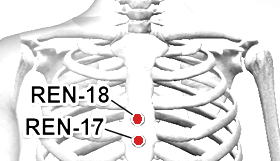
              Ren Mai (Directing Vessel)Front Collecting (Mu) Point β€” PericardiumFront Collecting (Mu) Point β€” Upper BurnerGathering (Hui) Point β€” QiPoint of the Sea of QiMeeting point (Ren Mai β€’ Spleen β€’ Kidney β€’ Small Intestine β€’ Triple Burner)

              Location

              Location of REN-17 (Shanzhong (or Tanzhong))

              Actions

              • Tonifies Qi and strengthens Gathering Qi (Zong Qi)
              • Opens the chest, regulates and descends Qi
              • Benefits the breasts and promotes lactation
              Key point: A major Qi-tonifying point (Gathering-Qi point + Sea-of-Qi point) but specifically for Lung-Qi/chest Qi, not Spleen or Kidney-Qi β€” combine with ST-36/REN-12/REN-6 if the deficiency is really Spleen- or Kidney-rooted.

              Indications

              Qi Deficiency

              Weak voice, tiredness, propensity to catching colds, spontaneous sweating.

              Chest

              Chest pain, wheezing, breathlessness, cough, fullness and oppression of the chest.

              Breast

              Insufficient lactation, breast abscess, breast distension.

              Clinical Pearls (summarized from Comments)

              • Needle towards the affected breast for lactation problems; insert horizontally downwards when used to tonify/move Qi.

              REN-22

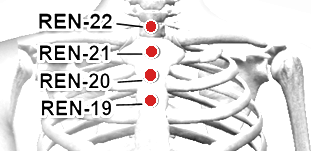
              Tiantu "Heaven Projection"
              Ren Mai (Directing Vessel)Point of the Yin Linking Vessel (Yin Wei Mai)Window of Heaven Point

              Location

              Location of REN-22 (Tiantu)

              Actions

              • Stimulates the descending of Lung-Qi
              • Resolves Phlegm
              • Benefits the throat and voice
              Key point: An important local throat point, widely used in both acute and chronic cough/asthma to resolve Phlegm and bring Lung-Qi back down.

              Indications

              Respiratory

              Cough, wheezing, breathlessness, rattling sound in the throat, phlegm in the throat.

              Throat

              Feeling of obstruction in the throat, throat ulcers, swelling of throat, dry throat, hoarse or sudden loss of voice, goitre.

              Clinical Pearls (summarized from Comments)

                REN-23

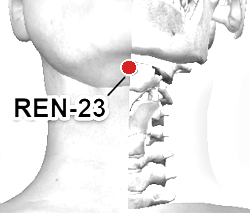
                Lianquan "Corner Spring"
                Ren Mai (Directing Vessel)Point of the Yin Linking Vessel (Yin Wei Mai)

                Location

                Location of REN-23 (Lianquan)

                Actions

                • Benefits the tongue and speech
                • Subdues rebellious Qi
                Key point: Mostly used for aphasia or slurred speech following Wind-stroke β€” combine with HE-5 for speech difficulties.

                Indications

                Speech / Tongue

                Swelling below the tongue, difficulty speaking, sudden loss of voice, aphasia after Wind-stroke, contraction/protrusion of the tongue, dry throat, mouth/tongue ulcers.

                Respiratory

                Cough, wheezing, breathlessness, vomiting of foamy saliva.

                Clinical Pearls (summarized from Comments)

                  REN-24

                  Chengjiang "Saliva Receiver"
                  Ren Mai (Directing Vessel)Meeting point (Ren Mai β€’ Du Mai β€’ Large Intestine β€’ Stomach)Sun Si Miao Ghost Point

                  Location

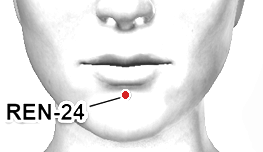
                  Location of REN-24 (Chengjiang)

                  Actions

                  • Extinguishes interior Wind
                  • Removes obstructions from the channel in the face
                  Key point: A local point for Wind invading the face β€” facial paralysis and deviation of the mouth β€” reflecting the Directing Vessel's pathway circling the mouth up to the eyes.

                  Indications

                  Facial Wind

                  Hemiplegia, deviation of mouth, lockjaw, epilepsy, tetany.

                  Local

                  Pain and numbness of the face, swelling of face, toothache, gum pain, sudden loss of voice, purple lips.

                  Clinical Pearls (summarized from Comments)